From the Archives of Swami Jyotirmayananda
In the vast ocean of Vedantic philosophy, seekers often encounter a challenging paradox: If God is the infinite, formless Absolute (Nirguna Brahman), why do we worship Deities with names and forms (Saguna Brahman)? For the intellectual mind, this can become a stumbling block. Skepticism arises, and the sweetness of devotion is replaced by dry logic. In this profound teaching, **Sri Swami Jyotirmayananda**, the last direct disciple of Swami Sivananda, guides us through the Balakanda of the Ramcharitmanas to reveal how the “Story of God” is not a contradiction to Truth, but the very vessel that carries us to it.The Hardness of the Unmoved Heart
Swamiji begins by referencing a powerful metaphor from Lord Shiva. The heart that does not thrill with joy upon hearing the glories of the Divine is compared to a rock. When we are consumed by Vishaya Rasa (the taste for sensory pleasures), our spiritual sensitivity dulls. We may be intellectually sharp, yet spiritually blind. The cure is **Satsanga** (spiritual company) and **Bhakti** (devotion), which soften the heart and prepare the mind for higher knowledge.The Divine Virtues (Daivi Sampat)
To understand the Absolute, one must first cultivate a foundation of ethical purity. Swamiji lists the Daivi Sampat (Divine Wealth) that flourishes when one listens to the Ramakatha:- Abhayam: Fearlessness
- Sattva-samshuddhi: Purity of heart
- Ahimsa: Non-violence
- Satyam: Truthfulness
- Shanti: Peace
Reconciling the Two Aspects of God
The central question posed by Parvati in the scripture is one that echoes in the minds of many modern students: “Is the Rama who is the son of Dasharatha the same as the Supreme Brahman?”
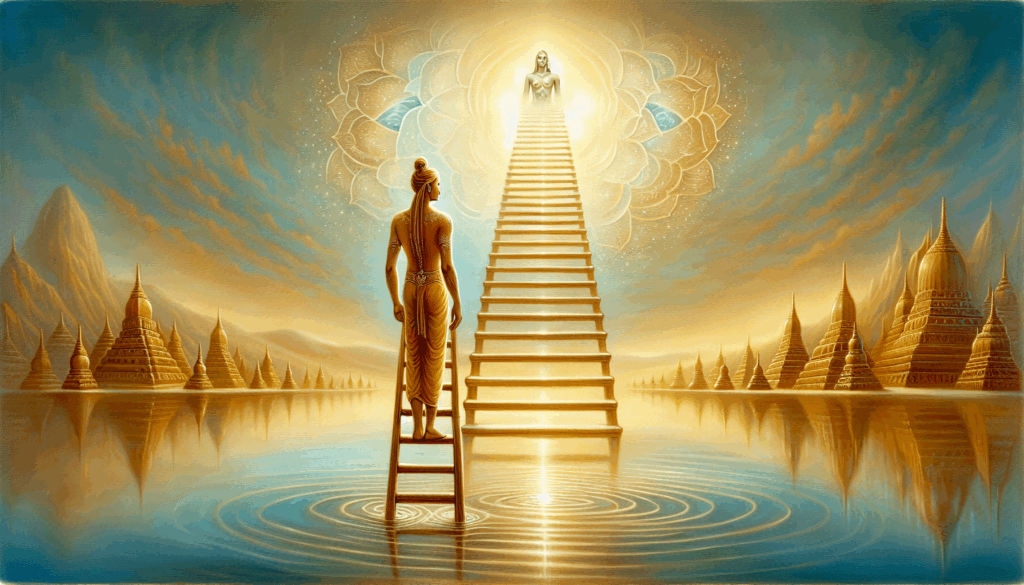
- Saguna Sakar: God with Form. This is the practical level where the mind finds support. We meditate on the attributes of Rama or Krishna.
- Saguna Nirakar: We feel a profound Presence that thrills us, beyond just the physical form, yet still possessing attributes like compassion and love.
- Nirguna Nirakar: The Formless Absolute. The mind attains a state of total tranquility, like a lake without waves, reflecting the sky perfectly.
Conclusion
The Ramakatha acts as an axe (Kuthari) to cut down the tree of worldly existence. By integrating the love for the Personal God with the understanding of the Absolute, we bridge the gap between the heart and the head.Scholar’s Corner
- Source Text: Sri Ramcharitmanas by Goswami Tulsidas.
- Section: Balakanda, Doha 112.
- Key Scripture: Bhagavad Gita Chapter 16 (Reference to Daivi Sampat).
Glossary of Terms
- Saguna: With attributes/qualities.
- Nirguna: Without attributes; the Absolute.
- Bhakti Rasa: The sweet essence of devotion.
- Moha: Delusion; emotional attachment to the unreal.
- Vishaya: Sense objects/worldly pleasures.
Join the Digital Sangha: https://bit.ly/4dgDWKn