
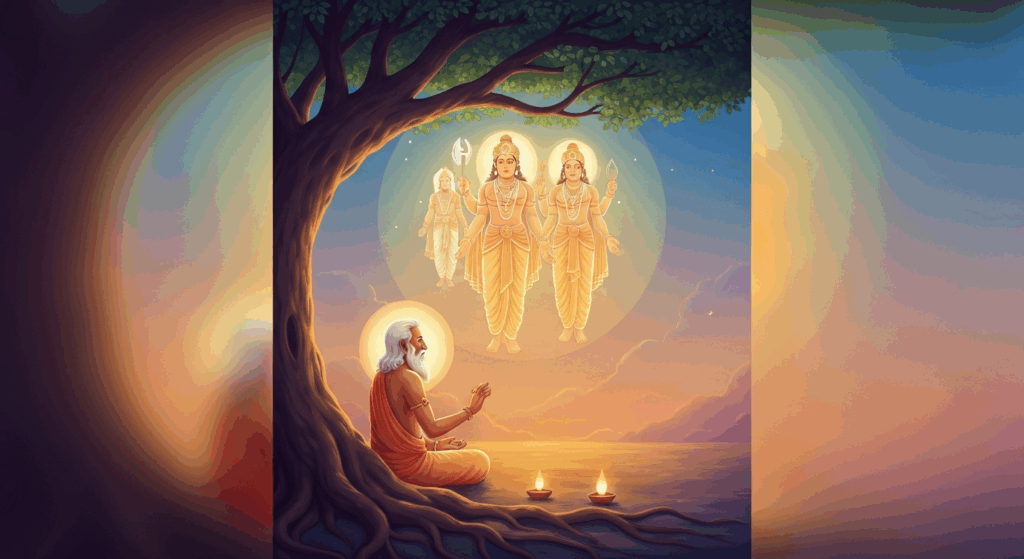
There is a question that runs quietly beneath much of religious life: if Lord Rāma came, if Lord Kṛṣṇa came, if Jesus came — and the world still bears its suffering — then what did the incarnation actually accomplish?
Sri Swami Jyotirmayananda, the last direct disciple of Swami Sivananda, faces this question without flinching in Lesson 66 of the Tulsi Rāmāyaṇa Series. The answer he gives is not a defense of theology. It is an invitation to see the scripture the way it was meant to be seen: as a tenacious mirror of the soul’s own interior process.
This profound class, recorded on July 21, 2017, at the Yoga Research Foundation in Miami, Florida, delves into the Balakanda of the Rāmcaritmānas. This is the Birth Canto of the Rāmāyaṇa, composed by the revered poet-saint Tulsidās, specifically as the text approaches Verse 121, where Lord Śiva commences narrating the Rāmāyaṇa to Pārvatī Devī.
Before diving into the direct teachings of the text, Swamiji pauses to explain the unique structure of the Rāmāyaṇa. It’s not a linear narrative but a profound, multi-layered tapestry of wisdom. The text features different teachers and disciples, each forming a “spiral” — a distinct, yet interconnected, path into the same essential wisdom:
- Yājñavalkya teaches Bharadvāja
- Śiva teaches Kākabhuśuṇḍi
- Kākabhuśuṇḍi teaches Garuḍa
“You are entered into a temple,” Swamiji explains, “and come to one spiral. Everything looks the same when you get to the other spiral.” This repetition, he clarifies, is not redundancy. Instead, it’s the scripture’s masterful way of touching every layer of the human personality — engaging us through devotion, stimulating the intellect, speaking through symbol, and captivating with story.
Rāma Beyond the Mind: Why Brahman Cannot Be Grasped
At this juncture in the Balakanda, the text imparts a crucial teaching: Rāma is beyond the range of intellect, beyond speech, beyond mind, and beyond ego. Swamiji takes a moment here to address a common experience among sincere spiritual aspirants: the mind’s relentless attempt to construct a concept of God — and the inevitable frustration when it fails.
“Even when you say Brahman is Satcitānanda,” he explains, “that is the best your intellect can do.” However, the experience of Brahman is fundamentally different from the concept. He offers a vivid analogy: “The concept is like imagining the ocean from a description. The experience is standing at the shore.”
This realization is not a cause for despair, but rather for profound release. The intellect’s inherent inability to fully contain or grasp Brahman is, paradoxically, the very sign that Brahman is real, boundless, and ultimately beyond mental constructs.
Ārohana and Avatāraṇa: The Two Movements of Liberation
The very heart of this illuminating class lies in Swamiji’s teaching on the real, interior meaning of divine incarnation. He draws inspiration from the profound opening declaration of the Balakanda: whenever there is a loss of dharma and the rise of demoniac forces, God incarnates.
Swamiji is careful to clarify his stance. He does not dismiss the historical reality of great teachers and avatāras. However, he masterfully refocuses the teaching on its crucial interior application: “The spiritual movement is not history. How things have happened in the past have no bearing upon you unless you draw some lesson from it.”
The profound lesson, he teaches, is this: whenever you develop sincere spiritual aspiration — whenever you become honestly aware of what is dharma and what is adharma — and when that awareness is diligently supported by satsanga (company of the wise) and sādhana (spiritual practice), two powerful movements commence simultaneously:
- Ārohana: The soul begins its ascent, climbing step by step, toward the radiant light of its own inherent nature.
- Avatāraṇa: Simultaneously, God begins to descend — to touch the ascending soul, to encourage its journey, and to gently guide it through the entire process.
“In every individual, that process goes on,” Swamiji affirms. The incarnation is not a distant event waiting to happen; it is a living, dynamic reality unfolding right now — inside each and every soul that turns sincerely toward the light of truth.
Four Paths as One Movement: Karma, Bhakti, Dhyāna, Jñāna
Swamiji then brings us back to a teaching central to the mission of the Yoga Research Foundation: the four traditional paths of integral yoga are not separate roads but rather a single, unified movement of the whole personality.
“I have just put it in four fingers,” he says, “but these four go together.” He elaborates on how they integrate:
- Karma Yoga: Righteous, selfless action performed in the world.
- Bhakti Yoga: Devotion, purifying the emotional nature through profound love of God.
- Dhyāna Yoga: Meditation, the practice of focusing and stabilizing the mind.
- Jñāna Yoga: Wisdom, the direct recognition of one’s true nature as Brahman.
He further adds a vital teaching on the purification of the mind through what he calls the “three Bs”:
- Bhajan: Sacred chanting and devotional singing.
- Bhojan: Consuming sattvic (pure, wholesome) food.
- Chintan: Deep spiritual reflection and contemplation.
When these practices are diligently cultivated, the mind becomes purified. The profound result is dhruvasmṛiti — the absolute, unwavering recall of the Mahāvākya (Great Saying): Aham Brahmāsmi. This translates to the ultimate realization: “I am Brahman.”
Sumati, the Sanat Kumāras, and the Two Victories
In the later portion of this enlightening class, Swamiji presents two teachings that warrant particularly careful attention:
1. The Blessing of Sumati (Right Understanding)
The first teaching focuses on sumati — right understanding — which Swamiji declares is “the greatest blessing that can be given to any human being.” It is the profound quality that renders a person “absolutely independent, not dependent upon anything in the world.” Why? Because with right understanding, you know intrinsically that you are not merely the body, nor the mind, but the eternal soul, one with God.
2. The Allegory of the Sanat Kumāras: Jaya and Vijayā
The second teaching delves into the allegorical story of the four Sanat Kumāras — Sanak, Sanandana, Sanatkumāra, and Sanatsujāta. These divine beings represent the four aspects of the enlightened mind (manas, buddhi, chitta, ahaṃkāra) in their liberated state. Their significant encounter with the gatekeepers of Lord Viṣṇu — Jaya and Vijayā — introduces one of the Rāmāyaṇa’s deepest allegorical teachings.
Jaya, Swamiji explains, symbolizes relative success — the accumulated merit and purity (sattva) that enables the soul to gradually turn its attention away from worldly distractions and towards the path of liberation. Vijayā, on the other hand, represents absolute victory — liberation itself.
The soul’s inherent “default setting,” he teaches, is corrected through three progressive stages:
- The turning away from purely worldly pursuits.
- The dedicated focus on dharma (righteous conduct).
- Finally, the full and unwavering orientation of the inner life toward ultimate liberation — Vijayā.
Sanskrit Glossary
- Ārohana
- Ascent; the soul’s upward movement through spiritual practice toward liberation.
- Avatāraṇa
- Divine descent; God’s movement downward to meet and guide the ascending soul.
- Dharma
- Righteous conduct; the cosmic order of right action.
- Satsanga
- Company of the wise; association with truth-seekers and sacred teachings.
- Sādhana
- Spiritual practice; disciplined effort toward self-purification and liberation.
- Dhruvasmṛiti
- Absolute recall of “Aham Brahmāsmi” (I am Brahman).
- Sumati
- Right understanding; the highest inner quality.
- Viveka
- Discriminative wisdom; distinguishing the real from the unreal.
- Vijayā
- Absolute victory; liberation.
- Jaya
- Relative victory; worldly success and accumulated merit.
- Satcitānanda
- Existence-Consciousness-Bliss; the nature of Brahman.
The Rāmāyaṇa, therefore, is not a story that merely ended two thousand years ago. It is a timeless narrative that concludes — if such a word can even apply — the moment the soul recognizes itself in the divine figure of Rāma: the Brahman that was never separate from what you have always inherently been.
Sri Swami Jyotirmayananda, the last direct disciple of Swami Sivananda, has dedicated his life to making this profound recognition available to all — one insightful lecture, one transformative class, one sacred scripture at a time.
Continue Your Journey
-
Join the Digital Ashram: Discover daily wisdom, in-depth study guides, and access the complete archive of teachings. Explore the Digital Ashram
-
Support the Mission: Help us ensure these invaluable teachings reach more sincere seekers around the globe. Support Our Work
This study guide is drawn from the archived teachings of Sri Swami Jyotirmayananda.