
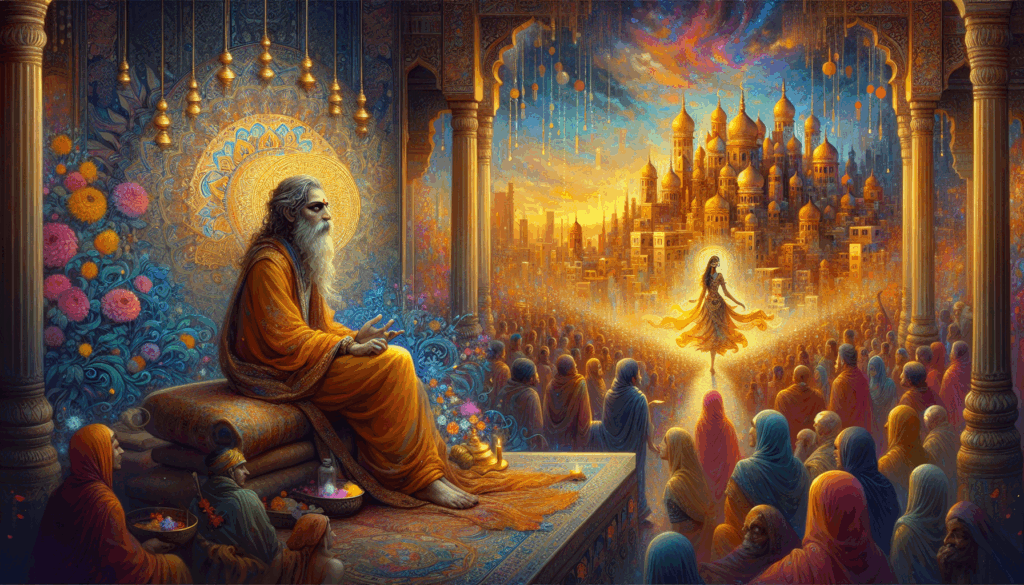
In this evening’s profound session from the Ramcharitmanas, Balakanda, Sri Swami Jyotirmayananda addresses a question many spiritual seekers often shy away from. He begins with the compelling story of Sage Narada, who famously triumphed over Kamadeva, the God of desire. Most retellings conclude there, celebrating Narada’s victory.
However, Swamiji reveals that the true teaching unfolds in what followed: the subtle pride that crept into Narada’s heart through repeatedly recounting his success, and the extraordinary “surgery” God performed to lovingly remove it. Narada’s journey, Swamiji suggests, is ultimately every seeker’s story.
No Prayer Goes in Vain
Swamiji opens with one of his most direct and powerful teachings: “No prayer goes in vain.” He emphasizes that even a mechanical recitation, or a stotra performed with a wandering mind, initiates a positive spiritual movement. Yet, the true potential of prayer, he explains, is far vaster than most people ever realize.
“The real power of your prayer will blow your mind away.”
This immense power, Swamiji clarifies, only fully blossoms as the heart opens. And the heart, in turn, opens through the holistic practice of Integral Yoga – a beautiful integration of:
- Action (Karma Yoga): Selfless service and right conduct.
- Emotion (Bhakti Yoga): Devotion and love for the Divine.
- Understanding (Jnana Yoga): Spiritual knowledge and wisdom.
- Meditation (Raja Yoga): Control of the mind and senses.
Prayer, therefore, is not an isolated act. It is the natural fruit of the entire personality turning sincerely toward God.
Narada’s Story: The Mystic Continues
The stage is set: Sage Narada has just completed intense tapas (austerity). Fearing Narada’s escalating spiritual power, Indra, the king of the gods, dispatches Kamadeva, the God of desire, to disrupt his profound concentration. Kamadeva, however, fails utterly; Narada remains completely unmoved. Humbled, Kamadeva surrenders and seeks forgiveness.
Narada, demonstrating a magnanimous heart, pacifies Kama with loving words. Up to this point, it is a clear triumph of spiritual discipline.
But then, the subtle shift begins. Narada first visits Lord Brahma, reporting his success. Next, he goes to Lord Shiva, recounting his victory again, this time with even greater enthusiasm. Lord Shiva, ever compassionate and discerning, offers a quiet, gentle warning: “Do not repeat this story further.” Narada, however, does not heed this subtle counsel. Driven by a burgeoning sense of accomplishment, he proceeds to Lord Vishnu.
Lord Vishnu’s Dry Face
Lord Vishnu receives Narada, but not with the warm praise and validation Narada anticipated. Instead, Vishnu greets him with a “rukha vadan” – a dry, expressionless face. There is no commendation. Instead, Vishnu speaks a profound Truth.
He tells Narada that those who lack jnana (spiritual knowledge), vairagya (dispassion), and brahmacharya inevitably fall under the influence of what He terms “manobhava pida” – suffering that arises from within the mind itself.
Swamiji then details the six gross impurities, or malas, of the mind:
- Kama: Desire
- Krodha: Anger
- Lobha: Greed
- Moha: Delusion, born of ignorance and attachment
- Mada: Pride, an intoxication that makes one deaf to wisdom
- Matsarya: Jealousy, the impulse to diminish others
These six malas, Swamiji notes, operate across all three planes of existence – physical, subtle, and causal – profoundly affecting our experience of reality.
Two Stages of Vairagya
Drawing from the Raja Yoga Sutras, Swamiji elucidates the development of vairagya, or dispassion. It begins with lower vairagya, a conscious decision by the mind: “I will not be bothered by objects.” This progresses through distinct stages:
- Yatamana: The initial effort to control the senses.
- Vyatireka: The stage of discernment, where one identifies which desires have been overcome and which still persist.
Through these stages, the senses are gradually tamed, and the mind itself comes under control. Yet, Swamiji clarifies, this is merely the beginning.
The ultimate stage is higher vairagya, or para-vairagya. This profound state opens when the mind experientially realizes that all objects are unreal. This isn’t merely a philosophical concept; it’s a deep, transformative experience. Like a person waking from a vivid dream, they feel not grief at leaving the dream-objects behind, but immense freedom and relief.
The Real Meaning of Brahmacharya
Here, Swamiji offers a vital corrective to one of the most frequently misunderstood concepts in Indian spirituality: Brahmacharya. It is not, he asserts, merely celibacy. While celibacy can be a means to an end, brahmacharya is not defined by any external form or physical state.
“Carya is acharana, conduct. Conduct leading to Brahman. That is brahmacharya.”
A householder who raises a family in righteousness, whose mind ceaselessly recognizes all as Brahman, is arguably a truer brahmachari than one who is physically celibate but whose mind remains riddled with impurity. True brahmacharya is when the mind flows continuously and unhindered toward the Supreme, where the entire personality aligns itself toward liberation.
The Garvataru: God Performs Ego-Ectomy
Lord Vishnu, with His divine vision, perceives what Narada himself cannot: the “Garvataru” – the tree of conceit – beginning to sprout in his heart. Swamiji cites a powerful verse from the Ramayana to illuminate God’s unwavering vow:
Sakrd eva prapannaya tavasmiti ca yacate, abhayam sarvabhutebhyo dadamy etad vratam mama.
“This is my vow: even if the whole world is against you, I will lead you on. To anyone who surrenders even once, saying ‘I am Yours,’ I grant freedom from all fear.”
God’s response to Narada’s burgeoning pride is not condemnation or punishment. It is, instead, the strategic activation of His Maya. “I will uproot that sprout,” Lord Vishnu declares inwardly. “This is my vow.” This “ego-ectomy,” as Swamiji terms it, is not a punitive act, but an ultimate expression of divine love and mercy.
The City of Shilanidhi and Princess Vishwamohini
What unfolds next is one of the most beautiful and deeply allegorical sequences within the Balakanda. Lord Vishnu’s divine Maya orchestrates the manifestation of a magnificent, illusory world before Narada. Within this world stands a grand city, ruled by King Shilanidhi, whose name means “treasure of good conduct.” His daughter, Princess Vishwamohini (“she who charms all the world”), is holding a svayamvara – an ancient ceremony where a princess chooses her own husband from an assembly of suitors.
Narada enters this resplendent city and beholds the princess. In that instant, his hard-won vairagya completely dissolves. He finds himself utterly captivated, unable to avert his gaze. He tells the king, “Whoever marries her will become immortal and unconquerable.” But inwardly, a powerful desire takes root: he wants her for himself.
Swamiji explains this scene with great clarity and insight: it is a profound allegory. The world you perceive is a reflection of the vasanas (subtle desires) within your own mind. If vasanas dominate, the world appears as an endless invitation to indulge. If, however, the mind is purified, that very same world transforms into satsanga – a fellowship of truth, a constant reminder of the Divine.
Narada, lost in this illusion, forgets his japas, his years of tapas, his entire spiritual discipline. His fervent prayer now becomes: “O Brahma, how do I attain her?”
The Inward Smile of Lord Vishnu
Narada, in his infatuation, prays fervently to Lord Vishnu, asking for His divine rupa – His handsome, captivating looks – so that Princess Vishwamohini will choose him. Lord Vishnu appears before him. Narada’s heart leaps with hope and anticipation. He asks, with what he believes is full humility, for Vishnu’s form.
Vishnu smiles inwardly. “I will do the best thing for you,” He says. “I will never do anything other than what is best.”
The lecture concludes at this pivotal moment, leaving the immediate outcome suspended. Yet, the teaching is complete and profoundly clear: Maya is not merely a trap to ensnare us. It is, in God’s hands, a precise and loving surgery. God’s boundless love is not always expressed gently to our ego. Sometimes, the most loving thing God can do is to perform a radical intervention for our ultimate spiritual liberation.
Scholar’s Corner
Scriptural Citations:
- Ramcharitmanas by Goswami Tulsidas, Balakanda (Dohas throughout this section)
- Raja Yoga Sutras: Cited for the two stages of Vairagya (Yatamana, Vyatireka)
- Verse: Mana eva manushyanam karanam bandhamokshayoh, “Mind is the cause of bondage and release”
- Verse: Sakrd eva prapannaya…, God’s vow of protection (Valmiki Ramayana)
- Verse: Moha-mara-mada-mana-damanam, Lord Vishnu on liberation from the six malas
- Opening Mangalacharana: Om brahmandam parama-sukhadam kevalam jnana-murtim…
GLOSSARY
- Tapas
- Austerity; disciplined spiritual practice.
- Kamadeva
- The God of desire; corresponds to Mara (Buddhism) and Satan (Christianism).
- Mala
- Gross impurity of the mind.
- Kama
- Desire.
- Krodha
- Anger.
- Lobha
- Greed.
- Moha
- Delusion; attachment born of ignorance.
- Mada
- Pride; the intoxication that makes one unable to listen to wisdom.
- Matsarya
- Jealousy; the impulse to diminish others.
- Jnana
- Spiritual knowledge; knowing Brahman as the only Reality.
- Vairagya
- Dispassion; freedom from attachment to objects.
- Para-vairagya
- Supreme dispassion; the experiential realization that all objects are unreal.
- Brahmacharya
- Conduct leading to Brahman; not merely celibacy but total alignment of personality with the Supreme.
- Manobhava pida
- Suffering that arises from the movements of the mind.
- Vikshepas
- Impure subtle desires (vasanas).
- Avarana
- The veil of ignorance covering the Self.
- Garvataru
- The tree of conceit (garva = pride, taru = tree).
- Svayamvara
- Ancient ceremony in which a princess chooses her husband.
- Vishwamohini
- “She who charms all the world”; allegorically, the intuitive knowledge born of divine qualities (daivi sampat).
- Shilanidhi
- “Treasury of good conduct”; the king in the allegorical city.
- Karunanidhi
- “Treasure of compassion”; epithet of Lord Vishnu.
- Namah
- “Not me, not mine”; the surrendering syllable at the end of mantras.
- Stotra
- Devotional hymn.
Watch the full lecture: https://youtu.be/wPegw6bfUc
Join the Digital Ashram (Daily Wisdom on WhatsApp): https://bit.ly/4dgDWKn
Support this mission: https://bit.ly/3N3obPo
This study guide is drawn from the archived teachings of Sri Swami Jyotirmayananda.