From the Archives of Swami Jyotirmayananda
There is a moment in the Yoga Vāsiṣṭha that stops you if you let it. The Siddhas – realized beings who have dissolved their individual boundaries in the ocean of Brahman – are singing. King Janaka, ruler of vast territories, sits in his garden and hears them. And what do they sing? Not about the glories of conquest or the rewards of piety. They sing about the one thing most people ignore: the Self that is already present, waiting, behind every thought, sensation, and story the mind constructs.
This is the teaching Sri Swami Jyotirmayananda brings to life in Yoga Vāsiṣṭha #144, covering Sections 7, 8, and 9 of the Siddha Gīta in the Upaśama Prakaraṇa. It is a teaching about waking up to what you already have before you spend another lifetime chasing what you don’t.
The Siddhas begin with a verse of Sanskrit precision that Swamiji opens carefully: ahaṁ. In Sanskrit, “I am.” The letter A begins the entire range of vocal sounds. H closes it. The nasal M ties it shut. The Siddhas are pointing to something encoded in your very first-person sense: the real “I am” in every being spans everything that can be said, thought, or experienced. It is not a small personal identity. It is Absolute Consciousness wearing the costume of individuality.
Swamiji quotes the verse directly: aśiraskahakārābham aśeṣākārasaṃsthitam ajasram uccarantaṃ taṃ svam ātmānam upāsmahe — “We adore the Self, which is all-encompassing Reality, containing the entire range of verbal expressions from A to H, joined by nasal M.” Every time you say “I,” you are, unknowingly, pointing to Brahman. The difference between an ordinary life and an illumined one is whether that pointer has ever been followed all the way home.
The Three Rarest Blessings: Manuṣyatvam, Mumukṣutvam, Mahā-Puruṣa Saṃśraya
After the philosophical opening, the Siddhas shift to something practical. They name three conditions that, when they come together, represent the most extraordinary fortune a soul can have:
- manuṣyatvam (human birth)
- mumukṣutvam (the longing for liberation)
- mahā-puruṣa saṃśraya (refuge with a great soul, a teacher)
Swamiji lingers on the first. Would you have been a squirrel? A crow? A frog? No matter how magnificent those forms are, they are bound entirely to instinct. A human being has something different: rationality that can become intuition, intuition that can become realization. You can ask “Who am I?” in a way no other creature in the known universe can. That capacity is manuṣyatvam. It is not a guarantee of wisdom. It is a door. Most lifetimes, the door is walked past without a second glance.
The second blessing — mumukṣutvam — is the burning. Not a mild curiosity about spirituality, not a passing interest in meditation apps, but a genuine, unquenchable aspiration to be free from the cycle of projection and suffering. And the third is finding someone who has crossed that river and can show you the way.
Mūrkha: The One Who Backs Into the Egg
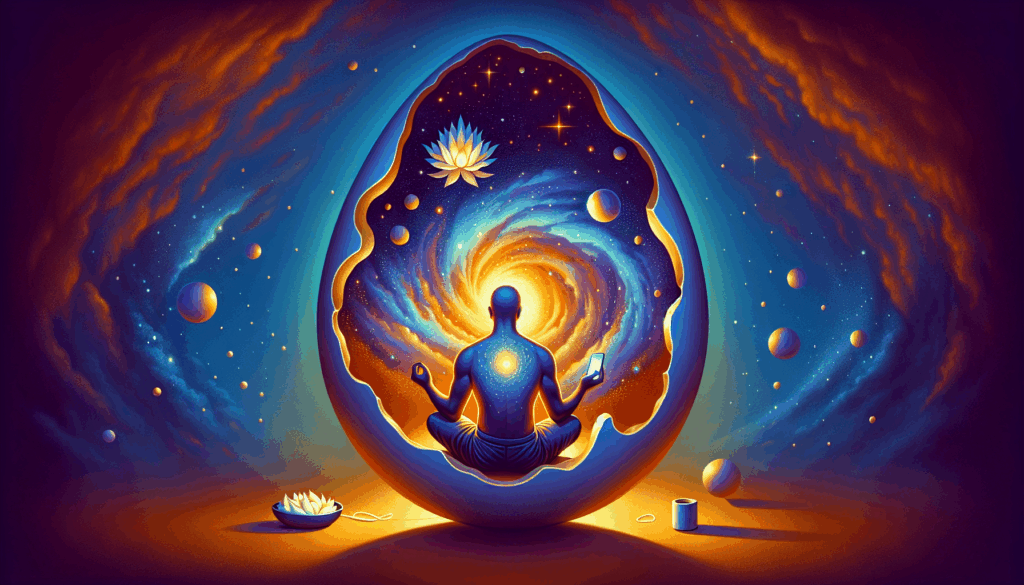
Against this backdrop of rare blessings, the Siddhas introduce a word: mūrkha. Usually translated as “fool,” Swamiji breaks the Sanskrit down more precisely. Kha refers to ākāśa, the open sky — the freedom of expansion. Mūrcchana means to contract, to faint, to turn away. So a mūrkha is one who, standing at the open door of the sky, backs up into the egg. Cozy. Safe. Small.

This is not a character judgment. It is a description of the default function of the untrained mind. It prefers the familiar cage to the terrifying expanse of the unknown. The Kaustubha gem — the mythic stone that fulfills all wishes — is already in every person’s possession. And yet the mūrkha trades it for colored glass every lifetime.
Śreya and Preya: The Fork Present in Every Moment
The Kaṭha Upaniṣad speaks of two paths that appear before every soul: śreya, the good and wholesome choice, and preya, the pleasant and immediately gratifying choice. Swamiji brings this into the ordinary morning. You wake up. The dawn is clear. The time for meditation or a walk in fresh air is there. Your pillow is also there. Five minutes more. Then five minutes more. By the time you are truly awake, the morning is gone.
This is not a small thing. Repeated falling for preya becomes a groove in the mind. The path of least resistance deepens. What feels like a trivial choice — snooze or sit — is the same fork that has led souls through countless births without progress. Constant vigilance, Swamiji says, is the answer. Not violent suppression of the senses, but the steady application of understanding: I know this does not lead where I want to go.
Janaka Climbs to the Uppermost Room
After hearing the Siddhas, King Janaka does something remarkable. He rushes back to his palace — not to celebrate, not to issue proclamations. He climbs to the uppermost room and sits alone to reflect. The Yoga Vāsiṣṭha describes this physically, but Swamiji reads it spiritually: the uppermost room is the highest level of your own mind, the one where past and future go quiet, where the question “Who am I?” can be held without noise.
Janaka’s reflection is an example of vairāgya in action. He is not depressed. He is growing. The text has him asking: Why am I so proud of this kingdom, which is a particle of dust? By the sweeping currents of boundless time, millions of Brahmās have been destroyed. Why do I place my trust in what is transient? This is not nihilism. It is the beginning of liberation.
Time Is a Play of the Mind: Anādi, Ananta
The soul, the Siddhas declare, is anādi — without beginning — and ananta — without end. Time itself, Swamiji explains, is a function of the mind: the mind’s movement between past and future creates the illusion of duration. In deep meditation, when the mind grows still, time dissolves. What is left is the eternity of the Self. The body’s lifespan, set against cosmic time, is a drop in an ocean. The soul, however, is the ocean. Identifying with the drop is the root error. Discovering the ocean is mokṣa.
Scholar’s Corner
- Scriptural source: Yoga Vāsiṣṭha, Upaśama Prakaraṇa (The Chapter on Tranquility), Siddha Gīta, Sections 7-9. The Upaśama Prakaraṇa is the fifth of six books in the Yoga Vāsiṣṭha. It addresses the actual practice of inner quietude, not as a mood but as a cognitive transformation.
- Lineage note: Sri Swami Jyotirmayananda received initiation and direct training from Swami Sivananda of Rishikesh. He founded the Yoga Research Foundation in Miami in 1962 and has taught Integral Yoga and Vedanta for over six decades. His commentary on the Yoga Vāsiṣṭha draws on both the Sanskrit original and the Vivekananda-era tradition of rendering these texts accessible to the Western-educated mind without diluting their philosophical rigor.
- On the three blessings: The triad of manuṣyatvam, mumukṣutvam, and mahā-puruṣa saṃśraya appears in slightly different formulations across Advaita texts. Adi Shankaracharya’s Viveka Chudamani (verses 2-3) identifies the same three as among the rarest gifts that grace bestows: human birth, the longing to be free, and the company of the great.
Sanskrit Glossary
- Aham (अहम्)
- Sanskrit first-person pronoun, “I am.” In Vedantic analysis, it encodes the entire range of sound from A to H and points to Absolute Consciousness, not merely the individual ego.
- Anādi (अनादि)
- Without beginning. A quality of Brahman and the true Self, which is not subject to time or causation.
- Ananta (अनन्त)
- Without end, infinite. Together with anādi, it describes the soul’s nature as beyond the grip of time.
- Kaustubha (कौस्तुभ)
- A mythic gem that fulfills all wishes, associated with Viṣṇu. Used here as a symbol of the Self, already present and priceless, which the ignorant trade for worldly distractions.
- Mahā-Puruṣa Saṃśraya (महापुरुषसंश्रय)
- Seeking refuge with or taking shelter in a great soul. The third of the three supreme blessings: finding and following a realized teacher.
- Manuṣyatvam (मनुष्यत्वम्)
- The condition of being human. In Vedanta, this is the embodiment most suited to self-inquiry and liberation, because of the human capacity for rationality, intuition, and conscious aspiration.
- Māyā (माया)
- The creative and concealing power of Brahman. The projection that makes the Absolute appear as the world of multiplicity. Sattva-predominant aspect of Prakṛti.
- Mumukṣutvam (मुमुक्षुत्वम्)
- The intense longing for liberation, for mokṣa. One of the four qualifications (sādhana-catuṣṭaya) listed in Advaita Vedanta as prerequisites for sincere spiritual practice.
- Mūrkha (मूर्ख)
- Commonly translated as “fool.” Swamiji breaks the term etymologically: mūrcchana (contraction, fainting) + kha (sky, expanse). The one who contracts away from the open sky of liberation.
- Prakṛti (प्रकृति)
- Nature, the creative matrix. The magical power of Brahman through which the three guṇas (sattva, rajas, tamas) manifest the entire cosmos including the cosmic functions of creation (Brahmā), sustenance (Viṣṇu), and dissolution (Śiva).
- Preya (प्रेय)
- That which is pleasing or immediately gratifying. The path of the senses and comfort, contrasted with śreya.
- Siddha Gīta (सिद्धगीता)
- Song of the Siddhas. A section of the Upaśama Prakaraṇa in Yoga Vāsiṣṭha, comprising the teachings of perfected beings (siddhas) heard by King Janaka in his garden.
- Śreya (श्रेयस्)
- That which is truly good, beneficial in the long run, conducive to liberation. The Kaṭha Upaniṣad presents it as the alternative the wise choose over preya.
- Upaśama Prakaraṇa (उपशमप्रकरण)
- The Chapter on Tranquility. The fifth book of the Yoga Vāsiṣṭha, dealing with the inner cultivation of quietude as a direct preparation for liberation.
- Vairāgya (वैराग्य)
- Dispassion, detachment from the objects of the senses. Not depression or world-rejection, but a mature understanding that no temporary object can give permanent happiness.
- Viveka (विवेक)
- Discrimination, discernment. The capacity to distinguish the real from the unreal, the permanent from the impermanent. Described here as the thunderbolt (vajra) with which the aspirant subdues the senses.
What does the “I am” in you point to right now? If you sit quietly for a moment — not looking at any object, not following any thought — what remains? That remainder is what the Siddhas have been singing about all along.
Watch the full teaching — Sri Swami Jyotirmayananda, Yoga Vāsiṣṭha #144: https://youtu.be/IjhOmj9WG38
Join our WhatsApp Digital Ashram for class reminders and study notes: https://bit.ly/4dgDWKn