
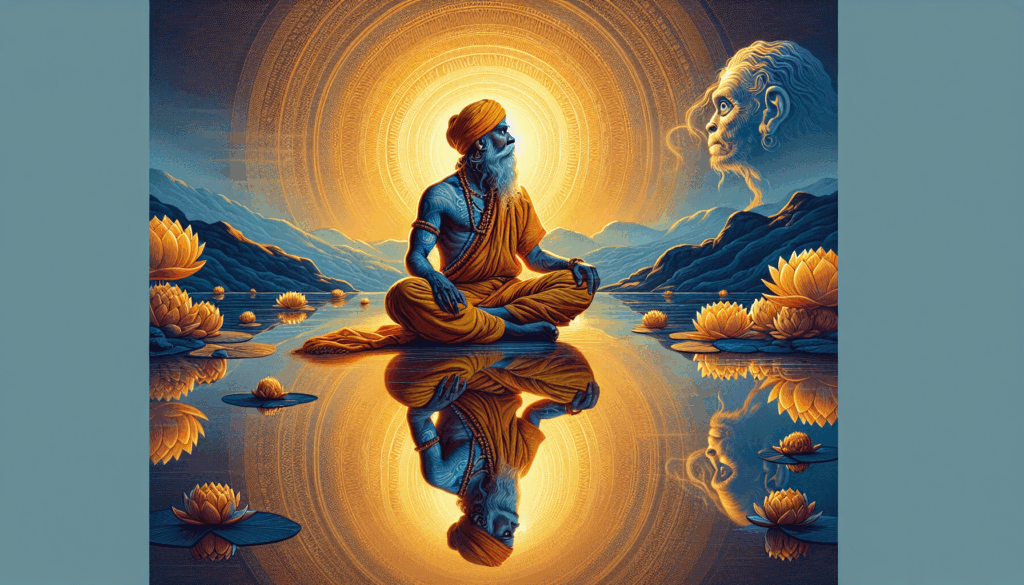
There is a moment in the Tulsi Ramayana, stripped of all metaphor, that is startling in its honesty. A great sage, Narada, gazes into a pond and sees a monkey staring back at him. Not a punishment handed down from a throne. A mirror. The face he has been wearing all along, finally visible.
Sri Swami Jyotirmayananda spent Session 71 unpacking this story in its full philosophical depth, tracing the arc from Narada’s inflated ego to the allegory of Ravana and Kumbhakarna. He arrived at one of the most direct summaries of spiritual life in the entire Ramayana canon: Purushartha plus Grace. Self-effort plus the opening of the Divine window.
Narada had just achieved something truly significant. He had practiced tapas (intense austerity), withstood the assault of Kama (Cupid, the God of desire sent by Indra), and emerged untouched. Any honest student would expect applause, and Narada certainly felt he deserved it.
But then something subtle happened. Narada began giving the credit to himself, rather than to the Divine or the path itself.
Swamiji is unsparing here: “When you attain something and give credit to your ego, that is the biggest mistake.” In Narada’s case, the ego grew until he believed himself greater than Shiva, Brahma, and Vishnu combined.
This is not mythology about a distant divine being. This is the story of every sincere practitioner who has one good year of meditation and begins, slowly, to see themselves differently: more knowing, more elevated, more special than others around them. The attainment was real. The credit, however, was tragically misplaced.
The Monkey Face Is Already There
Lord Vishnu, whose Lila (divine play) was operating behind the entire sequence, arranged a test. He created Vishwamohini, an enchantress described as Lord Vishnu’s Maya Shakti (the power of cosmic illusion), and orchestrated a swayamvara, a ceremony for her to choose a husband.
Narada, struck by desire, went to Vishnu and asked to borrow His beauty. Vishnu responded with the ambiguous precision of a doctor: “I will grant your boon exactly as a doctor gives what the patient needs,” not necessarily what the patient asks for.
What Vishnu gave Narada was a monkey face. Narada did not know this. He walked into the assembly of great personalities, confident, certain Vishwamohini would choose him. She turned away in horror. He moved seats. She turned away again, repulsed.
When the attendants of Shiva, the Shiva Ganas, held up a mirror, Narada saw. Body: human. Face: monkey.
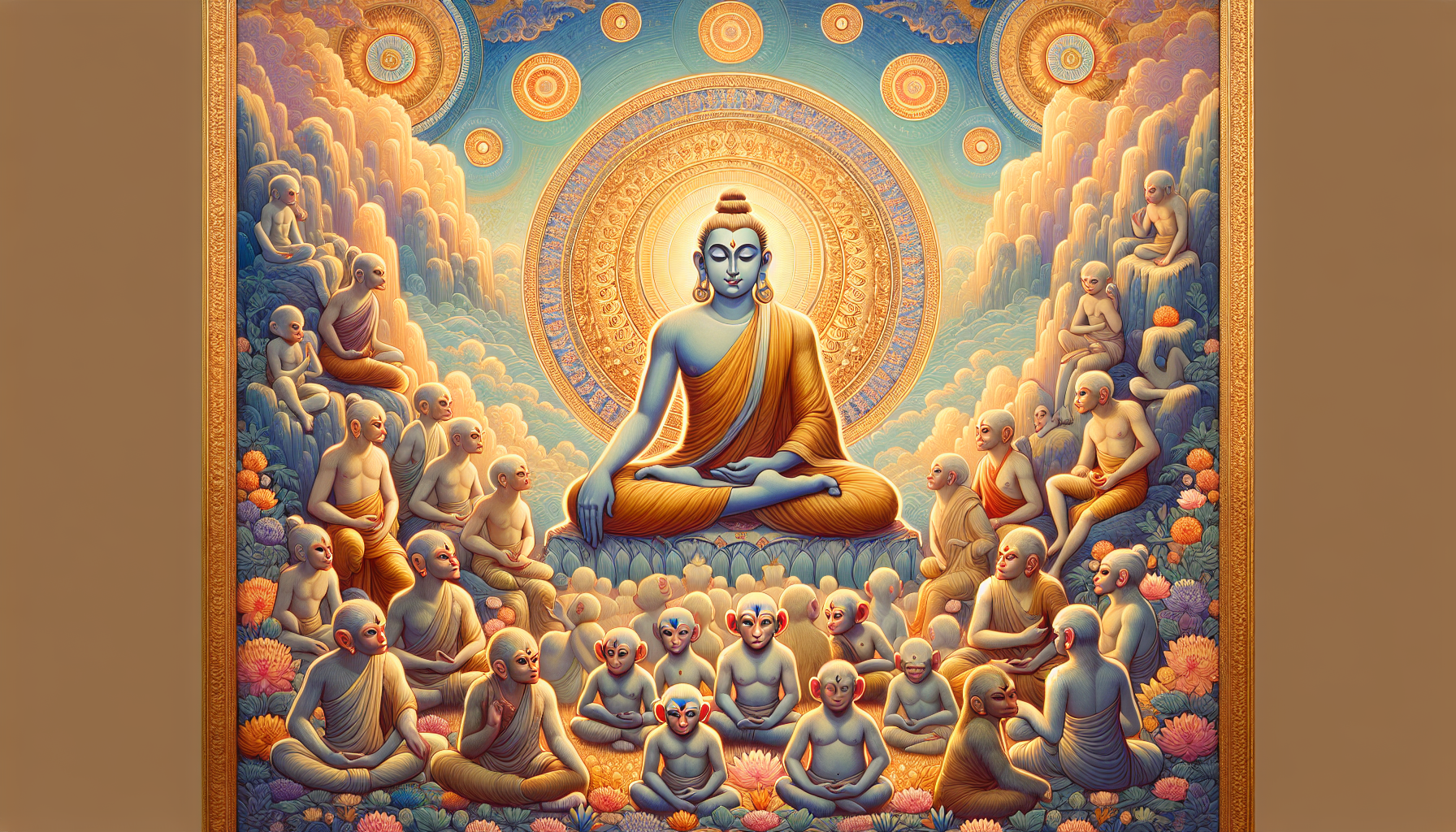
Swamiji’s reading is precise: the monkey face was not new. It was what inflated ego has always looked like. Vishnu did not punish Narada by creating a deformity. He simply removed the illusion that was hiding what was already there.
Para Sampada and Swa Sampada
When Narada confronted Vishnu in anger, the words he blurted out contained a profound philosophical key: “par sampada,” literally “the prosperity of the other,” or the wealth that is not yours.
Swamiji builds on this with the contrast between para sampada (the wealth of the not-Self) and swa sampada (the soul’s own real wealth). The body does not belong to you. The mind does not belong to you. The senses, the prana, the intellect: all of these are part of the not-Self, borrowed for the duration of a lifetime.
Just as everything you “have” in a dream vanishes at waking, none of it yours to keep, so too the entire apparatus of the personality is para sampada.
The soul’s real wealth, swa sampada, is the Atman itself: pure awareness, untouched by karma or time. This is what every soul is actually seeking, even when it thinks it is seeking beauty, power, recognition, or romantic union.
The Churning of the Ocean, Read Inward
From Narada’s story, Swamiji pivots to the allegory of the churning of the ocean (Samudra Manthan), reading it as an interior map of spiritual practice.
When the mind begins the churning process of sincere spiritual practice, the first thing that rises is poison: negativity, fear, latent desires, grief. The practitioner is often alarmed, wondering, “What went wrong?”
Swamiji’s answer: nothing went wrong. That poison was already taken by Lord Shiva. What you are dealing with is, in a certain sense, fake poison, already absorbed by the grace of the Divine. Recognizing that it has no ultimate reality is itself the remedy.
The parallel in Christianity is offered without apology: “Lord Jesus has already remedied all your sins.” The structure is the same. The poison of accumulated karma has been taken; the practitioner’s task is to believe it, act accordingly, and not treat the shadow as the substance.
Purushartha Plus Grace: The Mantra for Liberation
The monkeys in Rama’s army are not merely decorative. They represent the mind and senses: restless, energetic, always moving. The bears represent the subtler desires sitting in the subconscious.
Sita, held captive by Ravana, represents Viveka Buddhi (intuitive discernment). She is the quality that knows the real from the unreal, the permanent from the impermanent. She cannot be reached by ego alone; that is precisely why Narada, with all his genuine tapas, failed. She requires an integrated army: Purushartha (self-effort) led and graced by Rama (the Divine Self within).
Ravana, with ten heads and ten distractions, is the momentum of avidya (ignorance). Kumbhakarna is mala: the gross layer of impurity that makes the mind dull. As mala is reduced through practice, the joy of conscious living (bhoga) increases. As viksepa (mental scattering) is reduced, the soul comes closer to the final victory.
Swamiji’s formula is both simple and complete: Purushartha plus Grace. He summarizes it powerfully: “The monkey is your basis. Grace is Rama leading the monkeys.”
Scholar’s Corner
The Narada episode appears in the Balakanda of the Tulsi Ramayana (Ramcharitmanas), composed by Goswami Tulsidas in the 16th century in Awadhi. Tulsidas uses the story to establish the nature of Maya early in the text, before Rama’s birth, so that the reader enters the rest of the narrative already awake to the allegorical layer.
The term para sampada appears in the Isha Upanishad context: “Isha vasyam idam sarvam.” God pervades all. Therefore, renounce what is not yours. Do not crave others’ wealth.
Sanskrit Glossary
- Tapas: Austerity; disciplined spiritual practice involving heat, restraint, and concentration.
- Maya Shakti: The Lord’s power of cosmic illusion; the force that makes the unreal appear real and the real appear absent.
- Para sampada: The wealth of the not-Self; the body, mind, and senses that the soul mistakenly identifies with.
- Swa sampada: The soul’s own real wealth; the Atman, pure consciousness.
- Purushartha: Self-effort; the soul’s own striving on the path of dharma and liberation.
- Viveka Buddhi: Intuitive discernment; the faculty that distinguishes the eternal Self from the transient not-Self.
- Viksepa: Mental scattering or distraction; one of the three obstacles to liberation (along with mala and avarana).
- Lila: The divine play of God; actions of the Lord in the world that serve the soul’s evolution while appearing as ordinary or dramatic events.
Read more teachings by Sri Swami Jyotirmayananda at the Wisdom Journal.
Watch Session 71: https://www.youtube.com/watch?v=VTt5pDXLoGU
Support the mission: https://bit.ly/3N3obPo
This study guide is drawn from the archived teachings of Sri Swami Jyotirmayananda.