
There is a question the Bhagavad Gita poses that most seekers often overlook. It’s not about how calm you feel in a quiet room or on a peaceful retreat. The real question is this: what happens to your composure when everything around you is in turmoil?
Sri Swami Jyotirmayananda offers a profound answer in his commentary on Chapter 5, Karma Sanyasi Yoga: the equanimity that only holds in comfortable conditions is not true equanimity at all. It is merely a pleasant illusion. Real peace is what remains when the winds of life blow fiercely.
Every sincere aspirant eventually arrives at a fork in the path. One direction suggests: stay in the world, fulfill your duties, and let the demands of life shape your days. The other urges: leave everything behind, go to the monastery, and call it liberation.
The Vedic tradition, as Swamiji explains, recognizes both of these as incomplete on their own. The scriptures name them Pravṛtti and Nivṛtti, and they are vividly dramatized in the allegory of Caṇḍa and Muṇḍa, two opposing forces the Goddess must overcome.
-
The Pravṛtti Mind: Relentless Outward Pursuit
Caṇḍa represents the Pravṛtti mind: relentless, outward-reaching, and convinced that more activity, more achievement, or more involvement will finally deliver satisfaction. This mind finds no ceiling because all its attainments exist in the world of time and space, where nothing holds permanently.
-
The Nivṛtti Impulse: Withdrawal Without Transformation
Muṇḍa represents the Nivṛtti impulse: the urge to declare renunciation, shave the head, and withdraw. But withdrawal without inner transformation does not purify the heart. The energy simply finds another channel. In the absence of right direction, inertia takes over – a condition the tradition compares to the demon Kumbhakarṇa, where days of dullness are mistakenly called contemplation.
Both mistakes share the same root: they treat the outer circumstance as the problem, when the actual work is always inward.
What Karma Yoga Actually Means
Karma Yoga is not merely a middle path between activity and renunciation. It is a fundamentally different understanding of action altogether.
In Swamiji’s teaching, Karma Yoga means taking the same energy that drives ordinary worldly activity and redirecting it toward Citta Śuddhi, or purity of heart. The action itself does not necessarily change; rather, the quality of the doer changes. You bring to your duties an awareness that you are an instrument in God’s hands, not the architect of outcomes. Every task becomes a form of worship. Every encounter becomes a window onto the Divine.
The result is not withdrawal from the world. It is a progressively lighter grip on what the world owes you. Your sphere of concern naturally expands. The Sanskrit phrase Vasudhaiva Kuṭumbakam — “the world is my family” — moves from being an abstract idea to becoming a lived orientation.
What Purity of Heart Actually Means
Citta Śuddhi is the gateway the Gita points to again and again. But it is easy to mistake purity of heart for emotional suppression or detached performance.
Swamiji draws the distinction clearly. Citta Śuddhi is not the absence of feeling. It is the opening of the heart to God’s presence within every experience. As the layers of selfish attachment fall away through right action and surrender, the inner life becomes less cluttered. What was obscured becomes visible. The heart is not emptied; it is freed.
This is the real goal of Karma Yoga. Not efficiency. Not achievement. Not even peace in the ordinary sense. It is the progressive opening of a person’s awareness to the Reality that was always there, beneath all the noise.
Be the Sky: The Metaphor of Steadiness
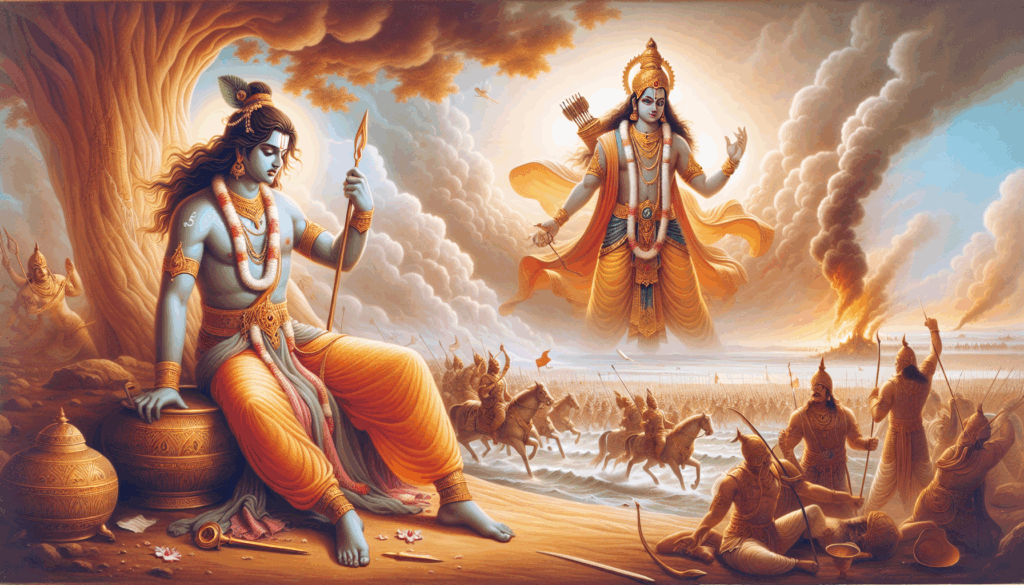
To make this tangible, the Gita offers a powerful picture: Kṛṣṇa and Arjuna on the battlefield of Mahābhārata. Arjuna is perspiring, overwhelmed, his bow falling from his hands. Kṛṣṇa sits beside him, calm like a blue sky behind thundering clouds.

The clouds move. The sky does not.
This is the image of a mind established in Karma Yoga. Fully present. Fully engaged. Not retreating from the storm, but not absorbed into it either. The world thunders, and in the middle of the thunder, there is a steadiness that the conditions of the world cannot touch.
This is what Swamiji calls the happy tree: the tree that bends in the wind, shaken outwardly, but rooted so deeply that no wind can pull it from the ground.
Three Keys to Inner Freedom
Chapter 5, Verse 24 names three qualities of the Karma Yogī who has advanced. Swamiji treats each as a key to understanding what inner freedom actually looks like.
-
Antaḥ Sukh: Inner Joy
The aspiration shifts from happiness-through-happenings to happiness-through-inner-development. External pleasures are not denied, but the seeker stops placing their entire weight on them. They become a thin layer over the surface of something deeper.
-
Antarārāma: Inner Delight in God
The term ārāma means both rest and sweetness. As the senses quiet and the mind becomes still, something opens underneath. Not a void, but a presence. Swamiji describes it as a kind of inner shower that takes away all the stress the ordinary mind accumulates, what happens in deep, dreamless sleep magnified and made conscious.
-
Antara Jyoti: The Inner Light of Consciousness
The Upaniṣads ask: what is the light that allows you to see, to think, to dream? The sun lights the physical world. The mind lights the senses. The intellect illumines the mind. But what illumines the intellect? That light is Brahman, the source of all consciousness, and it has nothing to do with anything physical.
Following this chain inward is the practice. And the ultimate goal is to recognize that you are not separate from that light. You are it.
The Identity That Does Not Change
In deep sleep, everything known about you dissolves. Your name, your role, your history: none of it is present. And yet something continues. Something watches the silence. That witness is what remains when all conditions fall away.
Swamiji holds this up as a pointer, not a philosophy. Each night you return to a state where the ego has no ground. The recharging that happens there is real. The question the Gita raises is whether you can bring that quality of ego-dissolution into waking life, intentionally.
The answer is yes. It is the practice called sannyāsa — not of place, but of identity. The renunciation of the conditioned self: not through flight, but through the recognition of who you actually are.
Aham Brahmasmi. I am Brahman.
That recognition, as Swamiji teaches, does not happen in one sitting. It deepens through years of right action, self-inquiry, and surrender. First there are many falls. Then fewer. Then the state the tradition calls brāhmī sthiti: a footing from which the aspirant cannot fall, only advance.
The destination is brahma nirvāṇa. Not a place. Not a reward. It is the complete release of kāma and krodha — desire and anger, the two roots of all bondage — and the recognition of the Self that was always free.
Scholar’s Corner
Scriptural Citations from This Lecture
| Scripture | Reference | Context |
|---|---|---|
| Bhagavad Gita | Chapter 5 (Karma Sanyasi Yoga), Verse 24 | Three qualities of the advanced Karma Yogī: Antaḥ Sukh, Antarārāma, Antara Jyoti |
| Devi Mahatmyam | Allegory of Caṇḍa and Muṇḍa | The two forces — outward desire (Pravṛtti) and passive inertia (Nivṛtti) — that the Goddess must overcome |
| Mahābhārata | Battlefield of Kurukṣetra | Arjuna overwhelmed; Kṛṣṇa established in perfect equanimity — the living image of Karma Yoga |
| Upaniṣads | Teaching on the inner light (Antara Jyoti) | The chain of illumination: sun → senses → mind → intellect → Brahman |
Lecture: Srimad Bhagavad Gita, Class 58 — Sri Swami Jyotirmayananda
Glossary
Sanskrit Terms in This Teaching
- Pravṛtti (प्रवृत्ति)
- The outward, activity-oriented path. The tendency of the mind to seek fulfillment through external achievement and engagement with the world.
- Nivṛtti (निवृत्ति)
- The inward, renunciation-oriented path. The impulse to withdraw from the world. Incomplete without inner transformation.
- Caṇḍa
- A force symbolizing the relentless outward-seeking mind. From the Devi Mahatmyam; overcome by the Goddess as part of the spiritual allegory.
- Muṇḍa
- A force symbolizing passive withdrawal. Represents tamasic inertia that disguises itself as renunciation.
- Kumbhakarṇa
- The sleeping demon of the Rāmāyaṇa. Here used to represent the state of dullness and inertia mistaken for contemplation.
- Citta Śuddhi (चित्त शुद्धि)
- Purity of heart. The central aim of Karma Yoga. Not the suppression of feeling but the progressive opening of the heart to God’s presence in all experience.
- Karma Yoga (कर्म योग)
- The yoga of right action. Performing one’s duties as worship, without attachment to outcomes, as a means of inner purification.
- Vasudhaiva Kuṭumbakam (वसुधैव कुटुम्बकम्)
- “The world is my family.” A teaching from the Maha Upanishad. The natural orientation of the purified heart.
- Antaḥ Sukh (अन्तःसुख)
- Inner joy. The first quality of the advanced Karma Yogī named in Gita 5:24. Happiness rooted in inner development, not external conditions.
- Antarārāma (अन्तरारम)
- One whose delight is within, in God. The second quality of Gita 5:24. The ārāma (rest and sweetness) found in the silence of the turned-inward mind.
- Antara Jyoti (अन्तर ज्योति)
- The inner light of consciousness. The third quality of Gita 5:24. The light that illumines the intellect itself — identified with Brahman.
- Brahman (ब्रह्मन्)
- The ultimate Reality. Pure, self-luminous consciousness. The substratum of all existence. What remains when all conditions fall away.
- Aham Brahmasmi (अहम् ब्रह्मास्मि)
- “I am Brahman.” One of the four Mahāvākyas (great sayings) of the Upaniṣads. The recognition of one’s true identity as the Self.
- Sannyāsa (संन्यास)
- Renunciation. Here used not in the sense of external withdrawal, but the inner renunciation of conditioned identity — the dropping of the ego.
- Brāhmī Sthiti (ब्राह्मी स्थिति)
- The state of being established in Brahman. A footing from which, the tradition says, the aspirant cannot fall — only advance.
- Brahma Nirvāṇa (ब्रह्म निर्वाण)
- Liberation in Brahman. The complete release of kāma (desire) and krodha (anger) and the recognition of the eternally free Self.
- Kāma (काम)
- Desire. Along with krodha, one of the two roots of all spiritual bondage according to the Bhagavad Gita.
- Krodha (क्रोध)
- Anger. The second root of bondage. Arises when desire is obstructed.
From a lecture by Sri Swami Jyotirmayananda, the last direct disciple of Swami Sivananda.
Watch the full lecture: https://youtu.be/Qq6EydTWsEw
Join the community — daily wisdom on WhatsApp: https://bit.ly/4dgDWKn
This study guide is drawn from the archived teachings of Sri Swami Jyotirmayananda.