
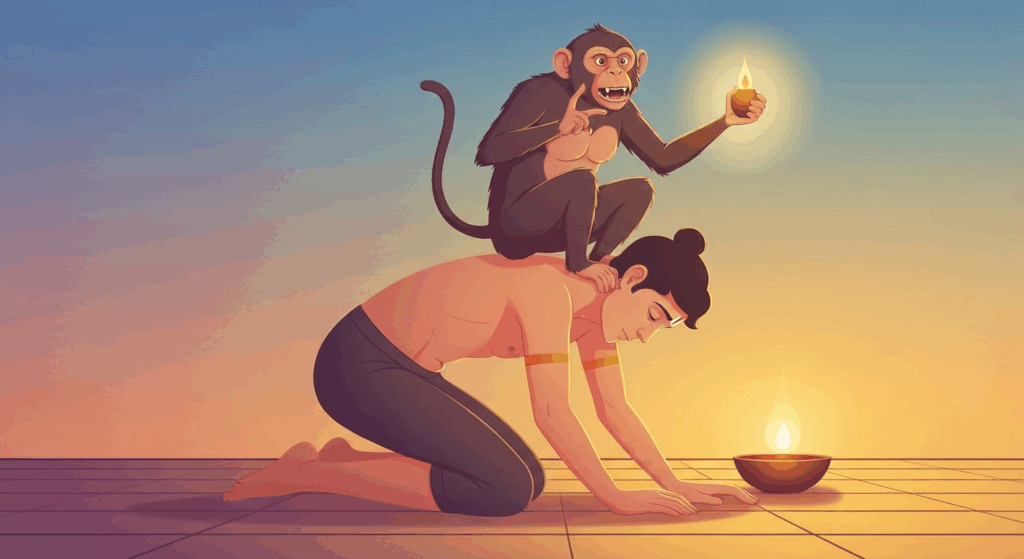
When bhoga, or sense pleasure, enters your mind, you are no longer its master. Indeed, bhoga is like a monkey that sits on your deck, demanding your attention. You find yourself subservient, asking, “What do you want?” like a slave. This is not real happiness; it is a degrading happiness, offering only a little thrill to your nervous system through sense pleasure, while leaving you eternally empty.
Before we delve deeper into this, let us invoke the divine:
oṁ pūrṇam adaḥ pūrṇam idaṁ pūrṇāt pūrṇam udacyate pūrṇasya pūrṇam ādāya pūrṇam evāvaśiṣyate ॥
oṁ śāntiḥ śāntiḥ śāntiḥ ॥oṁ brahmānandaṁ parama-sukhadaṁ kevalaṁ jñāna-mūrtiṁ dvandvātītaṁ gagana-sadṛśaṁ tattvamasyādi-lakṣyam ॥
ekaṁ nityaṁ vimalaṁ acalaṁ sarva-dhī-sākṣibhūtam bhāvātītaṁ sadguruṁ taṁ namāmi ॥ oṁ
This verse beautifully describes the Sadguru as Brahman, the giver of supreme bliss, the embodiment of pure consciousness. He is the one without a second, vast as the ether, infinite, eternal, and beyond the three guṇas (qualities of nature) and their modifications. Adorations to that supreme preceptor!
We are currently exploring the Upashamprakarna sections of the Yoga Vāsiṣṭha, which presents an allegorical description of how Śrī Rāma received these profound instructions. As the day concluded, everyone departed, and Rāma returned to his abode, deeply reflecting upon what he had learned. The next day, they all reconvened.
Many details in this narrative are not historical facts being retold, but rather a mystical depiction of what transpires at any given moment, especially within a satsaṅga (holy association). In a satsaṅga, souls at different levels of spiritual development come together. Though you may see everyone quietly listening, they are not all at the same level of understanding or experience. Just as various types of people—from those who ride horses to those who ride elephants—gather, so too do diverse souls assemble in satsaṅga.
The entire setting described—the palace hall where everyone gathers with King Daśaratha and Rāma—is an allegorical glorification of satsaṅga.
The Transformative Power of Satsaṅga
With the dawn of the next day, Śrī Rāma rose early during the soft hours of morning and performed his rituals. Accompanied by his brothers and friends, he proceeded to the residence of Sage Vashishtha. Royal officers, princes, sages, and brahmins also gathered there. This portrays a cultural pattern: they would respectfully bring Sage Vashishtha to the royal hall for his teachings.
Having entered King Daśaratha’s royal court, they took their seats, patiently awaiting Sage Vāsiṣṭha to begin. A soft breeze began to blow, and the atmosphere was truly inspired. This describes the satsaṅga setting, and you don’t need to go back to the Treta Yuga or wait for another era to experience it. Wherever there is satsaṅga, this is the atmosphere.
King Daśaratha broke the silence, saying, “O sage, just as the rays proceeding from the moon are cooling and refreshing, so too your words of wisdom have removed the feverish misery from our hearts and filled us with peace.” This is a profound, and not undue, appreciation of satsaṅga.
One must understand that all words are limited. Any guidance that leads you to God-realization, any atmosphere or association that facilitates this, nothing will compare with that as your greatest gain or achievement. As the saying goes, sat-saṅgatvenya-saṅgatvam (association with the good leads to the abandonment of all other associations).
Imagine gathering all the pleasures of the world—from swarga (heaven) to whatever your mind conceives as the highest pleasure—and bundling them up on one side of a weighing scale. On the other side, place just one moment of satsaṅga, a mere touch of its influence. The touch of satsaṅga will outweigh all that worldly pleasure. It’s a simple understanding.
You may have passed countless nights enveloped in shadows of darkness, with innumerable imaginations entering your mind. Yet, one ray of light makes a totally different change. Consider darkness versus light; bring out your scales of pain and pleasure. The teachings of a sage confer upon the listener the highest form of bliss.
King Daśaratha continued praising Vāsiṣṭha: “Your teachings are removers of mental illusions and destroyers of all negative karmas. They are the mystic anjant (collyrium), with the application of which one begins to behold the glory of the Self.”
The Guru’s Grace: Unlocking Jñāna Drishti
This glorification of the Guru reminds us of a powerful Guru Stotram (hymn):
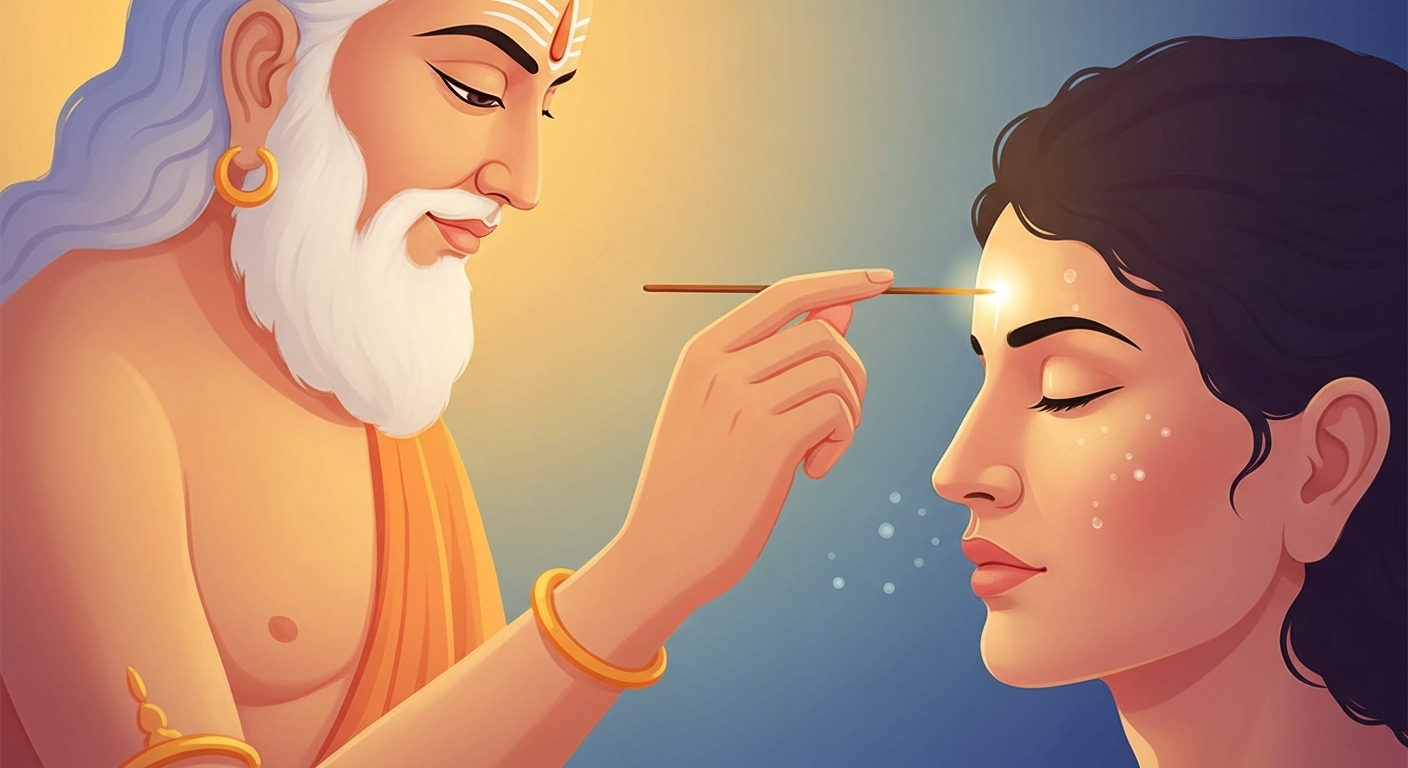
oṁ ajñāna-timirāndhasya jñānāñjana-śalākayā
cakṣur unmīlitaṁ yena tasmai śrī gurave namaḥ ॥
Adorations to that Guru who imparts spiritual wisdom! What does he do? For those suffering from the trouble of impaired eyesight—a trouble caused by ajñāna, the blindness of ignorance—the Guru, with jñānāñjana-śalākayā, carries a mystic little packet. In it, there is a mystic collyrium and a mystic little stick. He puts the stick into the collyrium and applies it to the eyes of the patients. Those who receive this jñānāñjana find their eyes open up.
Understanding Different Visions (Drishtis)
Now, try to understand, in a profound way, the importance of vision. Your physical eyes give you a practical vision of the world, and without them, you are a terrible loser. However, the normal vision of your eyes is extremely limited; you cannot even compete with animals that have sharper sight.
This vision of the physical eyes is called Charma Drishti — a vision that sees only the skin, never going beyond the superficial. There is also Brahmadrishti (deluded vision), where you have eyes, but something is wrong with your mental lenses, so you are not seeing things exactly as they are. Sometimes you even see doubles.
This deluded vision is often focused on finding where pleasure lies. But pleasure, in the worldly sense, is not real happiness; it is sense enjoyment, which is like a mirage. Your eyes lead you just like the eyes of a deer, which, in pursuit of shimmering water, follows a mirage created by sunlight refracting in a particular way, only to die in its fruitless quest. Though it appears like water, there is nothing there. This is precisely the predicament of all human experiences.
All that you enjoy, handle, eat, or hear is left behind the moment you “kick the bucket.” All your experiences are based upon your brain and nervous system, which allow you to have these experiences. This develops based on a limited consciousness.
Everyone is led by how they perceive happiness. If you find happiness in going to various hotels, that will be your Bhoga Drishti. If you want to watch sports, that will be another form of Bhoga Drishti. Bhoga Drishti can be positive or negative, but it is still Bhoga Drishti; it is not permanent.
The next type of vision is called Divya Drishti. This is a tricky term. If you engage in special yogic practices of sādhana and samādhi, you develop a certain type of mystical way of looking at things. You might look at a person’s face and know what they are thinking. Various psychic powers become possible. Divya Drishti can also imply seeing the whole world as an expression of God’s presence.
For example, Arjuna sees God, Kṛṣṇa, with a thousand heads and a thousand arms. But even after seeing all that, he is not satisfied, asking Kṛṣṇa to return to his normal form. So, Divya Drishti is an awakener, but if you are constantly seeing with Divya Drishti, you would simply be dancing, unable to handle any practical reality.
So, what is ultimately Jñāna Drishti? It is that type of vision that allows you to handle all things in a practical way, and at the same time, never lose sight of what is the truth. You see all illuminations of the sun but are not deluded by them; you know it is the sun. You are seeing the sun in all illuminations. You are seeing the truth behind all names and forms. That is the ultimate goal of all religions, and Vedānta highlights this as the Vedantic declaration.
This is the type of vision that spiritual teaching, the Guru’s teaching, imparts. You develop that magical spiritual vision, jñāna-drishti. To do this, you must apply the collyrium of wisdom (jñānāñjana-śalākayā) to your eyes. This is not to be taken literally; it means you listen to the scriptures again and again. By doing that, your eyes—not the physical eyes, but your mystic eyes, your inner understanding—begin to open up.
Assimilating Wisdom: Reflection and Inquiry
King Daśaratha expressed, “O sage, the teachings of sages like yourself bring delight to our hearts. Even a wreath of heavenly flowers placed upon a person does not cause as much delight as do the teachings that proceed from the enlightened sages.” We often wait for special celebrations, sometimes for months, to receive a beautiful flower as a welcome. Such worldly attainments are tremendous on a mass level, but they are nothing if you are led to satsaṅga and a subtle insight opens in your heart about ‘who am I?’ A revelation of ‘I am’—nothing can compare with it.
Turning to Śrī Rāma, King Daśaratha continued, “O best among the race of Raghu, a day spent in adoring the sages is indeed lit up with brightness, while all other days without such divine association are enveloped in darkness.” Adoring the sages is not to be taken literally as merely sitting and adoring. It means a day spent in satsaṅga, listening to the teachings, trying to understand them, and bringing them into your life. If you have not received this type of satsaṅga nourishment on any particular day, that day has been wasted. Just as a day without physical food for a healthy body feels wasted, likewise, your profounder reality, the real ‘I am’ movement, goes hungry.
All experiences that have simply allowed your mind to develop Bhoga Drishti—focusing on how enjoyable something is, planning for more elegant experiences next year—can be part of practical life, as long as you don’t become internally backward. If you do that, there’s no harm. But if that becomes your real happiness, hopping from one pleasure to another, then you are not progressing; you are losing the opportunity of your life.
Any plan you have can be executed, but if your plan is not under your control, and you are led by the plan, that is Bhoga Drishti. Once it enters your mind, you are not the master. Bhoga is a monkey; it sits on your deck, demanding your attention, making you its slave. This is not real happiness; it’s a degrading happiness. You lose life by giving a little thrill to your nervous system through sense pleasure, only to be eternally empty.
You might say, “Oh, life has been so wonderful; five years have passed, I don’t even know where time has gone.” It looks like a good thing. But in all these five years, your mind has been hammering away. The demon of attachment in you has practiced austerity; the demon of delusion has stood on one foot, unshaken. As a result, the demon becomes exceedingly powerful, and your lower self becomes your dominating reality. You can’t do anything about it. Now imagine the life ahead: the culture, the pain, the sorrow. One lifetime gives you a lot of it, but here is the unceasing cycle of birth and death. Therefore, life should not be taken as a joke.
The Importance of a Questioning Mind
Therefore, Rāma continued to ask Sage Vāsiṣṭha about the imperishable Self. Another point being highlighted is that the satsaṅga atmosphere is not just about listening, but about presenting your doubts and having them cleared. If you are before a highly adorable person, you might not ask any questions, and most religions utilize that setting. However, the Vedic religion presented a very bold view: if you are with the Guru and you remain dumb, the Guru-disciple relation suffers inertia. Instead, you should go on asking questions, or, on the basis of sincerity, present what you truly cannot understand. Share how much you have understood from the Guru’s teaching and allow the Guru to confirm whether your understanding is correct or if you need to go a little further, as long as the slightest doubt exists.
But that, again, is an allegorical description. You don’t just sit back in your house with a paper and pad, sending emails. The Guru-disciple relation implies that you should be involved in your integral yoga practice day by day. Whenever there is a serious question or doubt, try to turn to satsaṅga talks. All this is not only allowed but commendable. Nothing should be accepted by the disciple simply because the Guru says so when it relates to the jñāna aspect, to knowledge.
Bhakti (devotion) and upasana (worship) are on a different level; you engage in them according to what suits your heart. You are the artist if you want to meditate devotionally on Rāma, Kṛṣṇa, or whomever. Let the God sit on the lotus or stand up; let him smile or have an aura around him. You are completely free in that. But when it comes to the question of understanding ‘who am I?’, it is not a matter of how you feel about it. It is a matter of discovering, allowing your intellect to be intuitional, and having the revelation of truths. Truth is just truth, so the jñāna movement is moving towards the truth.
Therefore, a questioning mind is a commendable feature, but it must be a sincere, questioning mind. That’s why you see in the Gītā, Kṛṣṇa explains so many things, but Arjuna suddenly says, “But I haven’t understood this! You are saying I have to control the mind.” Then Kṛṣṇa responds with Abhyasa (practice) and Vairāgya (detachment). Similarly, in Yoga Vāsiṣṭha, Vāsiṣṭha explains many things, including the seven steps of wisdom, but Rāma says, “But I’m not satisfied. I want to have more light in the mind.”
Unveiling Reality: Māyā and the Path to Enlightenment
Sage Vashishtha commenced, “Oh Rāma, do you recall the teachings of the previous day when I explained how this world is a product of Māyā, or cosmic illusion? And that Brahman has assumed the form of the world through his Māyā.” Vashishtha is giving the essence of these teachings: Brahmā satyam jagan mithya — Brahman alone is real, and all that you experience through your mind and senses is not real.
For easy understanding, consider all that you experience in your dream: it is not real. Nobody has to tell you that. It’s easy to understand. But while dreaming, you have no idea about this; you are experiencing it exactly as you would in your waking state. In your dream, if you are driving a car and it crashes, you can’t simply dismiss it. You can’t accept it. So, when you hear that the whole world is mithya (false), the mind gets completely in turmoil. How can it be possible? And yet, day after day, you see that situation. Upon waking, not a single grain of the grapes you ate in your dream, nor a needle-point of land from your dream, can you bring into reality. Exactly the same applies to this waking world.
Your senses are not the ultimate realities. Your body goes on changing; it cannot even stay the same for two days. Senses, mind, intellect, ego—all these are different layers of illusion, of Māyā. Therefore, no matter how the world may appear, your goal is to realize. And realization is just like waking up from a dream. In that realization, you know Aham Brahmasmi — I am Brahman.
Numerous worlds arise out of Māyā and are all experienced through ignorance. The mind is the basis; the mind is the cause of both bondage and release. The entire story of ignorance and its destruction goes along with your mind. Once the mind resolves or is transcended, the whole world is transcended.
Authentic Teachings and the Sattva State
When such teachings proceeding from the sages are reflected upon again and again, the first point is that teachings must come from a highly experienced source. The teaching should not come from a mind that is narrow-minded. Today, many teachers specialize in devotion to only Viṣṇu, or only Śiva, or only the Mother Śakti. If you spend a year in one āśrama worshipping Śiva, you might be told in another to discard that worship, claiming Śiva is Tamasic. And when you happen to go to a Christian setting, you might be told to discard all that. I don’t need to give you more details. Such is not teaching.
Profound teaching is universal. Spiritual teaching is supra-science. The truth is absolutely cosmic, universal, absolute reality. So, there is no question of presenting distorted teachings to people. In other words, if you find that source where this authentic teaching is being given, that is the real ideal setup. And those teachings must be listened to (śravaṇa), and after listening, you must reflect (manana). You must assimilate; don’t keep it only as data in your mind.
Śrī Rāma said, “O sage, I have passed the night reflecting upon your nectarine teachings.” As I told you, Rāma saying he “passed the night” should not be taken literally as merely staying awake. It implies that Rāma has worked upon it, living his life reflecting upon the teaching and assimilating it. “Your words of wisdom are delightful to hear, and they are yet more delightful when reflected upon.” Someone gives you a whole bag of chocolates with a story of where they were found; it’s delightful to hear, but more delightful to start eating it.
“May the Kalpaka tree of your teachings continue to deck our lives with the fruits of spiritual wisdom.” The Kalpaka tree is a wish-yielding tree. This again allegorically highlights Bhoga Drishti. If you do good karma, why do you do it? So you can have more pleasure. Where do you go for this? To swarga, where the Kalpaka tree exists. You simply sit by the tree, and whatever you desire, whatever your fancy, the tree immediately presents it.
But Rāma says that the Guru’s teachings are even better than those heavenly Kalpaka trees. “O Sage, please allow the stream of purifying wisdom to flow on from your sacred lips.”
Sublimating Rajas into Sattva
Śrī Vāsiṣṭha continued, “O Rāma, just as a palace is sustained by its pillars, so too the world process is sustained by souls. Specifically, souls that are dominated by rajas and tamas—implying souls that are gripped by ignorance—for those souls, this world process exists as a reality.”
For souls that are enlightened, the world, depending upon different levels, becomes like an ocean that you are crossing over. It’s not there for you to live in, unless you are a fish. You have to cross over. But if you have a lot of tamas, then you do become a fish; the question of crossing over doesn’t even arise.
But those in whom sattva abounds—that’s the ideal. When sattva becomes sattva-sanshuddhi, sattva-bhakti, meaning sattva predominates, if that stage comes, you are now next door to enlightenment. Those in whom sattva abounds are able to renounce this world just as a snake sloughs off its outer skin. Sometimes you might have seen a whole snake slough; the whole snake shape is there, but the snake has walked out of it. So, your body, mind, your whole personality is a slough. The soul within you is a snake; it sneaks out of the slough. Those stuck in the slough don’t see the spirit behind it.
The rajas and sattvikas—souls which are gradually able to sublimate rajas into sattva—represent the ideal state in society. The majority of society is not qualified for spiritual progress. But that segment of society where people have developed a personality intent upon allowing their rajas to be sublimated into sattva—that stage has come. This means those who have developed themselves are aspirants. Such souls, as well as pure sattvikas, are inclined to practice spiritual reflection, in addition to performing good actions. They also practice good association.
What are the characteristics of those in whom rajas is being sublimated into sattva? These are the key points:
- Do not miss the opportunity of good association that creates thought-provoking spiritual movement (not merely thought-provoking for better, delicious foods, which is a different level, perfectly okay, but not the same).
- Study of scriptures: Do not just study roughly and say, “Oh, I have studied the Gītā; now I am studying the Upaniṣads. In one month I will finish ten Upaniṣads.” That is not real study. Study to understand what you are studying about.
- Listening to spiritual teachings: All this should be under the guidance of a Guru. There has to be an adept source. Just as you need someone to guide and teach you when learning music, dance, or any artistic talent.
Gradually, the impurities of their subconscious minds are reduced, and the intellect begins to shine like a lamp. If you follow these points—good association, study of scriptures, listening to the teachings, and practicing an integral way of living day by day—your very intellect becomes luminous, shining like a lamp. Your understanding removes all delusional thoughts. This continues until they are enlightened. This process of increasing Jñāna Drishti, the vision of wisdom, continues until your vision becomes the clear vision: “I am Brahman.”
And all that you are experiencing through the senses and the mind—they are like dreams; they are of the nature of Māyā. That type of experience places you, from a practical point of view, with double consciousness. Deep inside, a sage is untouched externally, as long as his personality exists. Many varieties of actions flow through his personality, and they become a source of inspiration and teaching for others.
The lives of sages are not always simple. Consider the difficult situations faced by incarnations like Rāma and Kṛṣṇa, or Christ himself. The lives of great sages may appear terrible from an external viewpoint, but the reality is totally different. The spirit of the sages remains completely untouched, and whatsoever happens through them serves to inspire others to follow the spiritual path. As the saying goes, Basanta Vaklo Kehite Charanta: the saintly personality becomes the spirit of spring. And once the spirit of spring enters a whole forest, the whole forest receives its impact; how it receives it, we cannot go into details.
The Ultimate Goal: Infinite Bliss
Co-aspirants, listen to the essence of all teachings: when the Self is not known by you, it creates misery and afflictions. This is the essential teaching. As long as you have not known the Self—known not in an intellectual way, but through realization, the intuitive, direct realization of “I am the eternal Self“—as long as you have not come to that level of experience, Aham Brahmasmi, “I am Brahman,” then you will face countless misery and afflictions.
On the other hand, if that knowledge has developed, when Brahman is known, when you realize “I am Brahman,” this gives rise to infinite bliss. That is the goal of life. And with this, I am concluding.
oṁ pūrṇam adaḥ pūrṇam idaṁ pūrṇāt pūrṇam udacyate
pūrṇasya pūrṇam ādāya pūrṇam evāvaśiṣyate ॥
oṁ śāntiḥ śāntiḥ śāntiḥ ॥oṁ pūrṇam adaḥ pūrṇam idaṁ pūrṇāt pūrṇam udacyate
pūrṇasya pūrṇam ādāya pūrṇam evāvaśiṣyate ॥
oṁ śāntiḥ śāntiḥ śāntiḥ ॥
This study guide is drawn from the archived teachings of Sri Swami Jyotirmayananda.