
From the Archives of Swami Jyotirmayananda
There’s a moment in the spiritual journey that often arrives without warning. You’ve diligently done the work: sat in practice, resisted temptations, navigated difficulties. A quiet satisfaction begins to rise within you—not exactly pride, but a profound sense of change. “I have changed. I am no longer who I was.”
According to Swami Jyotirmayananda, this very moment marks where the real test begins.
The Sage Nārada and Subtle Pride
The forty-ninth chapter of Tulsī Rāmāyaṇa’s Bālakāṇḍa illustrates this with incredible precision through the story of Nārada. The revered sage had undertaken intense tapasyā (austere spiritual practice). He remained unmoved even when Indra dispatched Kāma himself—the god of desire—to shatter his concentration. Kāma failed, falling defeated at Nārada’s feet. The victory was genuine. Yet, what followed wasn’t a reward; it was a subtle trap.
Nārada developed what Swami Jyotirmayananda terms “subtle pride.” He began to entertain the thought that he had surpassed even Brahmā, Śiva, and Viṣṇu combined. This is the pivotal point in the story, carrying immense practical weight. The true danger isn’t a dramatic failure. It’s the quiet credit the ego subtly takes for a truly earned achievement.
The Svayaṁbara of Vishwamohini: A Divine Intervention
In the divine plan, this kind of spiritual inflation isn’t punished; it’s treated. Lord Viṣṇu orchestrated a situation designed to deliver an unmistakable lesson.
Nārada happened upon a city bustling with preparations for a grand svayaṁbara (a ceremony where a princess chooses her husband). King Śīlanidhi—whose name means “ocean of good qualities”—was offering his daughter, Vishwamohini, “the enchantress of the whole world,” the right to choose her spouse.
Nārada saw the girl and, through his yogic sight, recognized her as Viṣṇu’s own māyā-śakti (illusory power). Desire surged within him, accompanied by a compelling logic: she deserves only the best, and there is no one better than me.
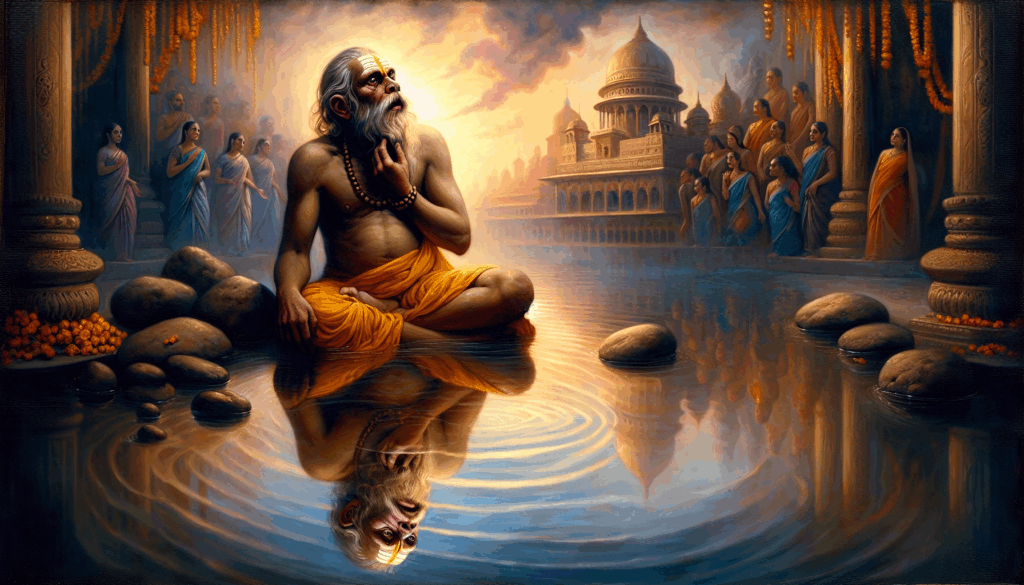
He approached Viṣṇu, requesting a beautiful form—specifically, haripad, the very appearance of Viṣṇu himself. Viṣṇu consented, granting him precisely what he needed, which was not what he wanted. At the svayaṁbara, Nārada felt magnificent. But when he caught his reflection in a pond, a startling monkey face stared back.

Viṣṇu, appearing as a radiant king, was chosen by Vishwamohini immediately. The two departed together in a chariot.
Nārada, utterly humiliated by his monkey face and shattered pride, confronted Viṣṇu in a torrent of rage. He cursed him, declaring: “parasampadā kahu nahi dekhi”—you cannot bear to see others prosper. This accusation speaks volumes. It is the voice of the ego, entrenched in its grievance, utterly blind to the profound teaching that had just unfolded.
Parasampadā and Svasampadā: The True Wealth Within
Swami Jyotirmayananda pauses on that crucial word—parasampadā—and illuminates the distinction central to this entire episode.
- Parasampadā is the wealth of the not-self: the body, senses, mind, intellect, and all the identifications the soul has accumulated through ignorance.
- Svasampadā is the real wealth: the intrinsic nature of the ātman itself, which is pure consciousness, bliss, and absolute freedom.
Most of human life is spent relentlessly chasing and protecting parasampadā, while largely ignoring svasampadā.
This, Swamiji explains, is precisely what God “cannot tolerate” in a devotee. It’s not out of jealousy, but because continued identification with the not-self is the very definition of bondage. The Lord’s disruption of Nārada’s comfort was not a punishment; it was a precise, surgical correction for spiritual growth.
“Fake Poison”: When Inner Darkness Isn’t What It Seems
The teaching reaches its most direct point when the churning of the ocean (samudra-manthan) appears in the commentary. This ancient Purāṇic story—where gods and demons churned the cosmic ocean to obtain nectar—is interpreted here as a map of interior experience for the spiritual seeker.
When a sādhaka (spiritual aspirant) engages in serious practice and begins to delve deeper, the first thing that often rises is darkness: old fears, dormant anger, buried impulses, and qualities that feel shameful. The natural response is alarm: “This is in me. I have not changed. I am worse than I thought.”
Swami Jyotirmayananda addresses this directly with profound reassurance: “That poison was already sucked up by Lord Śiva. What you are now dealing with is fake poison.”
The real poison—the deep karmic impurity—has already been absorbed and transmuted by Śiva’s grace. What surfaces in meditation is not evidence of failure. It is shadow without substance, a disturbance on the water’s surface rather than a creature lurking beneath. The negative qualities you encounter “have no reality.” They will not prevent liberation. They are simply the surface turbulence of a churning process that is already working in your favor.
This same profound understanding, Swamiji notes, echoes in the Christian tradition: Lord Jesus has already washed away the sins of the world. The structural insight is identical across traditions—the true weight has been taken up by the divine; what remains is the fear of a poison that no longer has its root.
The Formula for Liberation: Self-Effort Meets Divine Grace
When Viṣṇu withdraws his māyā at the end of the episode, the chariot, the princess, the rival suitors—all of it vanishes. There was nothing but Viṣṇu. Nārada, horrified by his words and actions, fell at Viṣṇu’s feet.
Viṣṇu’s response was characteristic: accept the curse with grace, dissolve the māyā, and impart the teaching. “All of this happened according to My will.” And the remedy for Nārada’s remaining distress was simple: recite the names of Lord Śiva.
This is where the Rāmāyaṇa’s deeper architecture becomes visible. Rāma and Śiva are not rivals in Tulsī’s poem; they are inseparable aspects of the same liberation. Rāma represents the Bhakti (devotion) movement; Śiva, the Jñāna (knowledge) movement. “Jñāna movement will not succeed without Bhakti,” Swami Jyotirmayananda says. “And Bhakti will not come to its climax without Jñāna.” Rāma himself declares in the Rāmāyaṇa: no one can be my devotee who is not also a devotee of Śiva. Śiva says the same in return.
The formula for liberation is both simple and profoundly challenging: Puruṣārtha plus grace. Self-effort—the organized “monkey army” of mind and senses under the direction of Rāma—joined to the divine grace that opens the window beyond ordinary knowing. Neither alone is sufficient.
You Are Nārada: The Universal Seeker’s Journey
Swami Jyotirmayananda concludes with a detail that transforms the entire story from mere allegory into a direct map for our own lives. Nārada is not simply a character. In the Purāṇas, Nārada is often placed as a scapegoat—whenever a great teaching is needed, Nārada is sent to receive it through direct, often humbling, experience. He embodies the very spirit of satsaṅga (spiritual company and instruction).
When you listen to the Rāmāyaṇa, you are Nārada. The monkey face arrives when it needs to arrive. The mirror it holds up is always, ultimately, the grace of the divine.
About the Source
Swami Jyotirmayananda is the founder of the Yoga Research Foundation (Miami, FL) and the author of nine volumes on Integral Yoga. The Tulsī Rāmāyaṇa commentary series is available on the Yoga Research Foundation YouTube channel.
YouTube URL: https://youtu.be/EvAd9z9wHlg
Awesome blog.
Great Post.
thisis a fantastic article, really nice created, i enjoy reading it, i will be back to check out for latest update, keep up the good work and applause. ng.yandaz.com