


What happens when a single human being attains supreme devotion to God? According to the Narada Bhakti Sutras, the effect is not limited to that individual. It ripples through every plane of existence. The forefathers clap their hands, the celestial beings dance, and the earth itself becomes sanctified. This is not mere poetry. It is a statement about the nature of consciousness and its power to transform everything it touches.
Liberation Is the Maidservant of Devotion
Sri Swami Jyotirmayananda explains that every person operates on three levels: body, speech, and mind. On the physical plane, our influence is limited. One farmer can tend one field, but there are millions of fields. On the plane of speech, the reach extends further. Words written down or recorded can travel across centuries and continents.
But it is on the plane of mind that the real transformation occurs. When the mind turns toward God-realization, layers of inspiring consciousness unfold that no recording device can capture. The sage tries to put this into words, but words are limited. Yet the thoughts of an enlightened being are not wasted. When thoughts are based on communion with God, they work wonders in ways that transcend ordinary understanding. This is how the Vedas came into existence, capturing in a limited way the infinite realizations of the ancient sages.
Devotion Beyond All Distinction
Sutra 72 of the Narada Bhakti Sutras declares: among devotees, there is no distinction based on class, knowledge, beauty, family, wealth, or occupation. Society instinctively venerates learning, expecting that one who attains God must hold countless degrees. But that is not how devotion works. Some of the greatest saints in India were illiterate. What they spoke from the purity of their hearts was so profound that scholars built their entire academic careers studying those words.
The story of Kevata, the simple boatman from the Ramayana, illustrates this perfectly. When Lord Rama needed to cross a river, Kevata refused to let Him board the boat until he could wash Rama’s feet. The dust of those feet, Kevata knew, had the power to transform stone into a living being. If it touched his wooden boat, he would lose his livelihood. Rama, Lakshmana, and Sita were charmed by this innocent devotion. Kevata washed the Lord’s feet not to Rama’s satisfaction, but to his own heart’s content. No Vedic learning was required, only the purity of a surrendered heart.

The Turtle and the Two Obstacles
Swamiji tells an ancient story to illustrate the two great obstacles on the path of devotion. Lord Vishnu sleeps on the cosmic milky ocean. A turtle from the salty ocean of worldly existence slowly makes its way toward His feet. But two guardians block the way: Lakshmi Devi, who represents worldly prosperity, waves her fan and drives the turtle back. Sheshanag, the cosmic serpent representing psychic powers (siddhis), breathes fire upon it.
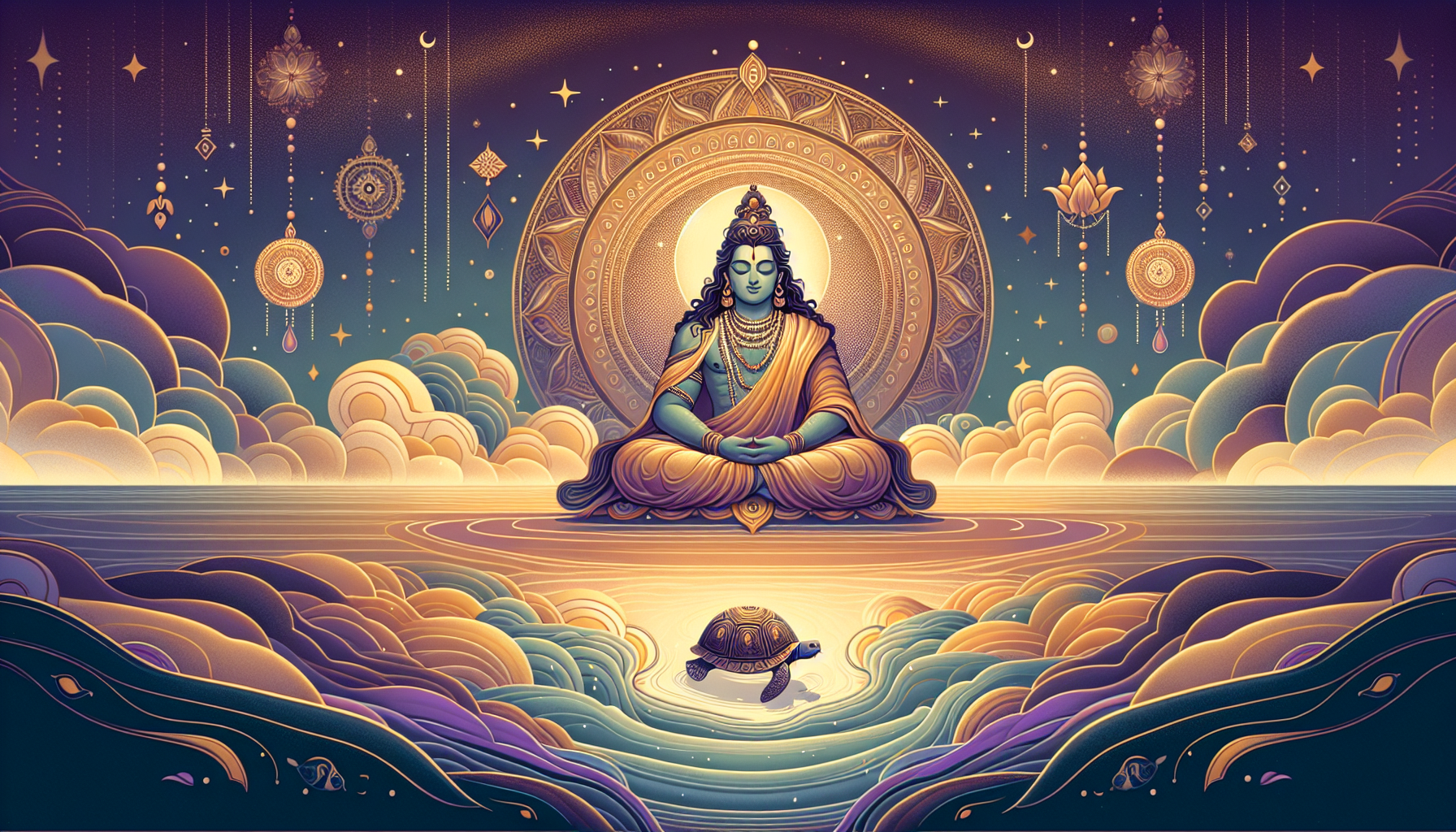
Every soul is that turtle. When sattva (purity) develops in the mind, the soul slips into the milky ocean and begins to approach God. But worldly success tempts it back. Or, if prosperity does not distract, the development of subtle powers through meditation becomes the new obstacle. Again and again, the soul is turned away.
But there comes a time, after many lifetimes of sincere practice under correct guidance, when the entire situation changes. Lord Vishnu is no longer sleeping but walking through the forest as Rama. Lakshmi is there as Sita, Sheshanag is there as Lakshmana, and the devotee no longer needs to fear them. God Himself extends His feet to the devotee. This is the culmination of parabhakti, supreme devotion, where all temptations of wealth and power have been transcended.
The Fire of Vain Discussion
Sutra 74 warns the devotee: vado navalambyah, do not take recourse to vain discussions. Spiritual debates, when driven by ego rather than sincere inquiry, kindle what the scriptures call vairavani, the fire of animosity. With every argument, the fire grows. Both the winner and the loser leave exhausted, having gained nothing.
The Upanishads confirm this: naisha tarkena matir apaneya, purified intellect does not develop through argumentation. True understanding comes through contemplation, not competition.
The Bhagavad Gita prescribes the antidote: austerity of speech. This means three things. First, satyam, truthfulness. Second, priyam, pleasantness. And third, svadhyaya, regular study of scripture. The ancient saying captures it: satyam vada, priyam vada, na vada satyam apriyam. Speak the Truth, speak it sweetly, and never speak a harsh truth without first learning how to make it palatable. In every heart dwells God. To hurt another’s feelings through careless speech is to wound the Divine presence within them.
The Beloved Everywhere
The saint Kabira described the culmination of devotion in a single verse: Lali mere Lal ki, jit dekhun tit Lal. “I went looking for the beauty of my Beloved, and I found that face everywhere.” In the beginning, the world looks crooked and full of troubles. The seeker runs from place to place. But when devotion matures, the face of the Beloved appears in every direction. And when the devotee finally looks in the mirror, no separate identity remains. Only God. That is the ultimate attainment.
Scholar’s Corner
The sutras covered in this lecture (71-74) form a bridge between the theoretical description of parabhakti and the practical warnings that protect the aspirant on the path. Sutra 71 establishes the supremacy of devotion over liberation itself, echoing the Bhagavata tradition where the devotee prefers service to God over the bliss of moksha. Sutras 72-73 dismantle social distinctions among devotees, a theme central to the Bhagavata Purana and the Alvars of South India. Sutra 74 introduces the concept of vada-tyaga (abandonment of argumentation), drawing from Katha Upanishad 1.2.9 and Bhagavad Gita 17.15.
From a lecture by Sri Swami Jyotirmayananda, a direct disciple of Swami Sivananda. Yoga Research Foundation, Miami, Florida.
Sanskrit Glossary
- Parabhakti (parābhakti) — Supreme devotion, the highest form of love for God where the devotee and the Divine become inseparable
- Siddhis (siddhiḥ) — Psychic powers that develop through advanced spiritual practice, considered obstacles if they distract from God-realization
- Sattva (sattva) — The quality of purity, harmony, and luminosity in the mind
- Kevata (kevaṭa) — The boatman from the Tulsi Ramayana who washed Lord Rama’s feet with innocent devotion
- Svādhyāya (svādhyāya) — Study of scripture, one of the austerities of speech prescribed in the Bhagavad Gita
- Vairavānī (vairavānī) — The fire of animosity that grows from repeated arguments
- Moksha (mokṣa) — Liberation from the cycle of birth and death
This study guide is drawn from the archived teachings of Sri Swami Jyotirmayananda.