
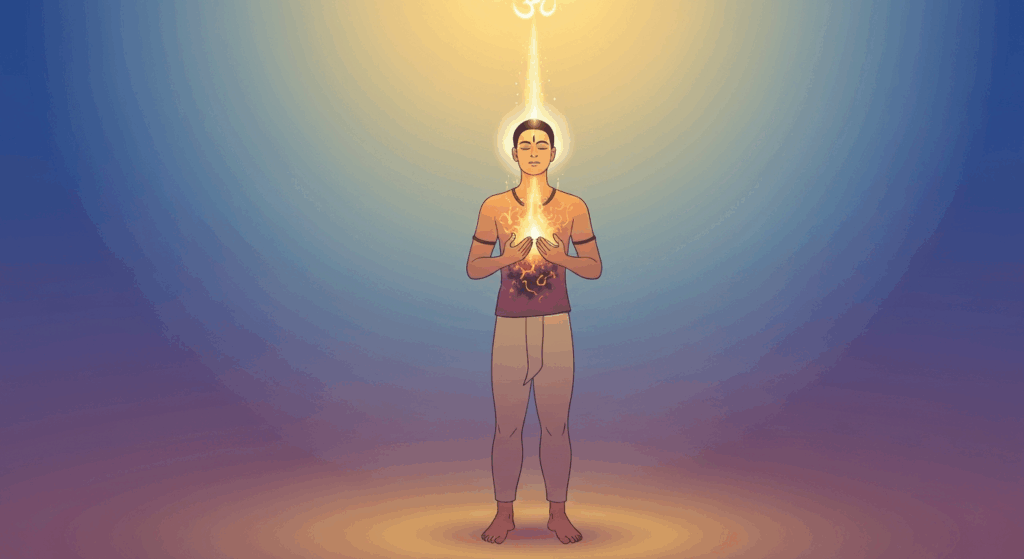
What if the secret to mastering anger isn’t fighting it, but redirecting it toward the very source of love itself? Most spiritual teachings tell us to simply suppress negative emotions, yet we find ourselves battling the same patterns again and again. Sri Swami Jyotirmayananda, a direct disciple of Swami Sivananda, offers a revolutionary approach in this profound teaching from Narada Bhakti Sutras Lesson 34. Drawing from Sutras 64-66, he reveals how every negative emotion can become a pathway to divine love when properly understood and directed.
Sri Swami Jyotirmayananda begins with a stark truth about human psychology: “When feeling is cramped, one lives a very shallow life. So day by day, the quality of life diminishes if the feeling is cramped.” Most people attempt to eliminate their negative emotions through pure willpower, creating an internal war that leaves them spiritually exhausted.
The Swami explains that this approach misses the deeper reality. Negative emotions are not foreign invaders to be destroyed, but misdirected divine energy. “Demons are the same energy that is expressed as love that becomes short-circuited and expressed as anger,” he teaches. “The same energy that expresses humility can be expressed as conceit.”
This understanding changes everything. Instead of waging war against parts of ourselves, we learn to redirect this powerful energy toward its true destination: God.
The 3S Formula: A Practical Method for Emotional Transformation
Sri Swami Jyotirmayananda introduces what he calls the 3S Formula for handling negative emotions like anger. This three-stage process works with human psychology rather than against it.

Stage 1: Suppress (Don’t Act It Out)
“As a negative sentiment tries to enter your mind. For example, anger is coming to your mind, it doesn’t even knock. Find a blanket, just put it over its head, and suppress it. The first stage is suppress, don’t act it out.”
This is not the suppression taught in psychology textbooks, where emotions are buried and forgotten. This is conscious restraint with a specific spiritual purpose. The Swami explains that any emotion expresses itself in three ways: “If you don’t restrict it, it will come into the stage of your words. Words will fly out of your tongue and will become extremely eloquent. You won’t even have to consult the dictionary once.” From there it moves to physical action.
The practice becomes progressively refined: first, control the physical response, then the verbal, finally the mental. “No matter how angry you are, your words remain completely under control, and of course, your body remains under control. So much so, you look at the person and smile as if nothing has happened.”
Stage 2: Substitute (Counter-Positive Qualities)
“The next stage is substitute. The counter-positive qualities that counter anger are love and forgiveness.”
During meditation and quiet reflection, we consciously cultivate opposite qualities. The Swami emphasizes this is active training: “Sit down for meditation, that’s the time you educate your mind.” Instead of hating ourselves for having negative emotions, we “bring a suggestion to yourself. It’s called asserting, assert within yourself.”
“Deep down I am a ray of God. It is natural for me to be God-like and that’s what I’m going to be. Therefore, I am growing in a positive direction and I am an embodiment… I am the embodiment of love.”
Stage 3: Sublimate (Direct to God)
The third stage represents the most profound teaching of this lesson. Rather than simply replacing anger with love, we redirect the energy of anger itself toward God. This is where the Narada Bhakti Sutras become truly revolutionary.
The Art of Directing Emotions to God: Breaking Spiritual Taboos
Sutra 65 introduces a concept that “to many, this is a novel idea presented by the Vedic culture. To others who are not well educated about it, the idea of directing anger to God or is blasphemy.” Yet Sri Swami Jyotirmayananda reveals this as the deepest secret of Bhakti Yoga.
“A devotee should direct his passion, anger, pride, etc. towards God alone.” This doesn’t mean becoming angry at God in the ordinary sense, but offering these energies to God with the underlying surrender of a child to its mother.
The Swami uses the beautiful analogy of a mother and child: “As a child grows, he has all those sentiments. He wants to be angry, wants to kick or scratch someone. But the target of all his actions is his mother. And nobody is hurt. The mother becomes exceedingly happy, so the child gets strength in the lungs and strength in his hands.”
The key is the deeper layer of surrender that never disappears: “Who else can protect me? Who else can support me and sustain me? That is never deleted, that’s always there.”
The Five Types of Bhavana: Choosing Your Devotional Approach
Sri Swami Jyotirmayananda introduces five distinct attitudes (bhavana) through which emotions can be directed toward God:
- Shanta (Peaceful): This is secretive devotion. “Outwardly, you wouldn’t know that someone is a devotee of God. He does japa. He doesn’t tell anybody.” Like Bhishma, this devotee maintains quiet, constant practice.
- Dasya (Servant): “I am an instrument in the hands of God. I am His slave. It’s not my will, let it be His will.” The advantage: “In a very good slave-master relationship, the slave enjoys all the blessings of the master. Only one thing he doesn’t enjoy, all the headaches of the master.”
- Sakhya (Friend): This is Arjuna’s relationship with Krishna. “You develop great confidence in relating yourself to God. So, you open up your heart.” The devotee can even say, “If you don’t like God, tell him. I am practicing truthfulness, sincerely speaking. You are not doing well with the world.”
- Vatsalya (Parental): “You love God with the tenderness of a mother and God is like a baby. You are not expecting anything. But the very fact that God can be loved by you is all that you want.”
- Madhurya (Divine Romance): “The most profound sweetness… human love at its height reflects that state when a devotee is in love with God. The only difference, he doesn’t fall. He’s going up and up.”
Breaking the Threefold Illusion: The Deepest Teaching
Sutra 66 reveals the ultimate goal of emotional redirection. Sri Swami Jyotirmayananda explains: “When you are practicing devotion to God, there is a triad. You are the worshipper. God is worshipped and there is an act of worship that you are performing to please God.”
“As long as your devotion has these three components, your devotion is at a lesser level.” The goal is the dissolution of this separation: “If you are in profound love of God, love has blossomed and your individuality seems to fade away, then all the three have blended.”
He quotes the saint Kabira: “I went out to look for the beauty of my beloved… Everywhere there was the beloved. There wasn’t anything that was not the beloved.” Eventually: “I myself became the beloved.”
How to Apply This Teaching: A Practical Framework
Start with the 3S Formula for any negative emotion:
- Notice without justification: “The first point to understand is that it is something that diminishes me. I will be much better off if I have control.”
- Suppress physical and verbal expression: Develop progressive mastery over body, speech, then mind.
- Substitute during meditation: “Think of God… see that quality blossoming in that personality.” If dealing with anger, “See God, Jesus, Buddha, Krishna, and Rama, absolutely radiating peace and boundless love.”
- Direct the energy to God: Choose your relationship (servant, friend, parent, lover) and offer the emotion: “O God, I’m angry with you!” with underlying surrender intact.
- Trust the process: “When these sentiments are directed to God, they all become sublimated because God is the destroyer of demons.”
The Power of Sublimated Emotion
Sri Swami Jyotirmayananda concludes with the extraordinary power that emerges from this practice: “When anger doesn’t enter the mind, the energy of anger has become sublimated. That’s love, divine love. The sublimation of anger is very powerful. Therefore, you can understand the power of sages and saints.”
He references Mahatma Gandhi: “Terrible turmoil occurred in the masses… but his silence was the power behind it. His goodness was the power behind it.” This is “Atmic bomb, not an atomic bomb.”
“Buddha exploded it. Jesus exploded that bomb. All sages and saints have allowed that bomb to explode. Countless generations will continue to be affected by their radiations.”
Scholar’s Corner
- Scripture:
- Narada Bhakti Sutras, Lesson 34 (Sutras 64-66)
- Series:
- Narada Bhakti Sutras Series | Recorded at Yoga Research Foundation, Miami, Florida
- Key Sutras Covered:
-
- Sutra 64: Abhimaanadambhaadikam tyaajyam – “On the path of devotion, a devotee should renounce pride, hypocrisy, etc.”
- Sutra 65: Tadarpitakhilacharah san kamakrodhabhimanadi tasminneva karaniyam – “Having dedicated all activities… direct passion, anger, pride, etc. towards God alone.”
- Sutra 66: Trirupabhangapurvakam – “Breaking the triple form of relativity”
- References Cited:
- Srimad Bhagavata, Kabira’s poetry
- Sanskrit Terms Introduced:
- Bhavana, Shanta, Dasya, Sakhya, Vatsalya, Madhurya, Trirupa, Abhimana, Dambha
Sanskrit Glossary
- Bhavana
- Devotional attitude or feeling; the relationship one cultivates with God
- Shanta
- Peaceful devotional attitude; quiet, secretive practice
- Dasya
- Servant attitude; surrendering personal will to become God’s instrument
- Sakhya
- Friendship with God; confident, open relationship like Arjuna with Krishna
- Vatsalya
- Parental love toward God; tender care as if God were one’s child
- Madhurya
- Divine romance; the most intimate relationship of lover and beloved
- Trirupa
- The threefold form of devotion (worshipper, worshipped, act of worship)
- Abhimana
- Pride or ego-identification that must be renounced
- Dambha
- Hypocrisy; pretense in spiritual practice
- Samatva
- Equanimity; balanced state of mind toward all experiences
Conclusion
The teaching of directing emotions to God transforms the entire spiritual journey. Instead of viewing negative emotions as obstacles to overcome, we see them as powerful energies waiting to be redirected toward their ultimate source. As Sri Swami Jyotirmayananda teaches: “Convert every sentiment or direct every sentiment towards God.” This is not mere theory but a practical method that saints throughout history have used to achieve the highest spiritual realization.
The next time anger arises, remember: you’re not fighting an enemy, you’re redirecting divine energy back to its source. This is the revolutionary message of Narada Bhakti Sutras Lesson 34.
▶ Watch the full lecture: https://youtu.be/IxrzwnZyh9Y
🌐 Join the Digital Ashram: Daily wisdom on WhatsApp: https://bit.ly/4dgDWKn
🕉️ Support the Mission: Help spread this wisdom (Jnana Yagna). Donate here: https://bit.ly/3N3obPo
Connect with Us:
- Instagram: https://www.instagram.com/yogaresearchfoundation/
- Facebook: https://www.facebook.com/profile.php?id=100063553522695
- Twitter: https://twitter.com/swamijyotirmay7
- 📙 Yoga Research Foundation: https://yogaresearchfoundation.org
From a lecture by Sri Swami Jyotirmayananda, a direct disciple of Swami Sivananda.
This study guide is drawn from the archived teachings of Sri Swami Jyotirmayananda.
Many blessings to you Swamiji for bringing this exact message i needed to hear tonight….i was struggling with some emotional distress & this was the exact answer i was seeking!
Many prayers of blessings 🙌 to you & God 🙌
✨️🕉🙏💖✨️