
Every human being wants happiness. This is not a philosophical claim; it is the plainest observation anyone can make about life. From childhood through old age, every creature on earth is working toward a single goal: to feel happy. The spider, the tiger, the factory worker, the king—all are moving in the same direction.
But here is the trouble. The mind, which is supposed to help you find happiness, has actually been stealing it from you. King Janaka, the great philosopher-king of the Yoga Vasishta, arrives at this realization through sustained inner reflection. He declares: “I have caught the thieving mind which has been stealing my imperishable wealth of Divine Identity.” This is not a dramatic outburst; it is the quiet conclusion of a person who has looked carefully at the mechanics of his own suffering.
Not all happiness is the same. According to Vedantic teaching, there are three distinct types, and understanding them is the first step toward real freedom.
Tamasic Happiness: The Happiness of Numbness
Tamasic happiness is the crudest form. It is the happiness of numbness, unconsciousness, or escape. A person under the influence of intoxicants may feel temporarily free of pain, but this is not genuine relief; it is simply a shutdown of awareness. Likewise, the satisfaction of seeing an enemy punished falls into this category. The mind fixates on someone else’s downfall, ignoring every good thing in its own life.
Rajasic Happiness: The Happiness of Distraction
Rajasic happiness is the happiness of distraction. The mind sends out a hundred tentacles, each one pointing in a different direction: “There is happiness, there is happiness, there is happiness.” You chase one desire after another. Each one promises fulfillment but delivers only a brief release of tension before the next craving takes hold. This is the condition of most human lives: a restless cycle of wanting, getting, and wanting again.
Sattvic Happiness: The Happiness of Alignment
Sattvic happiness is orderly. It aligns you with the deeper purpose of your existence. But even sattvic happiness has stages. In its early form, sattva may still be under the control of rajas and tamas. The story of Vibhishana from the Ramayana illustrates this perfectly. In the early stages, Vibhishana is sattvic, but his sattvic nature operates under the domination of Ravana and Kumbhakarna. Only when Ravana expels him does Vibhishana turn toward Rama as his sole refuge. That is the turning point: when sattva is no longer compromised, and the soul can orient itself fully toward the Divine.
Shadows of Joy: The Illusion of Worldly Pleasure
One of the sharpest insights in this teaching is that worldly pleasure is only a shadow of real joy. You believe that a particular object or experience will make you happy, so you pursue it. If you get it, there is a brief sense of relief. But what you have actually collected is a shadow, not the substance.
Consider how people accumulate possessions. Money brings temporary comfort, but then you must protect it, multiply it, and guard against being cheated. The collection itself becomes a source of anxiety. As the Upanishads put it, worldly happiness is “alpam,” meaning small, limited, conditioned. Millions of shadows, crushed together, still do not contain one ounce of reality.
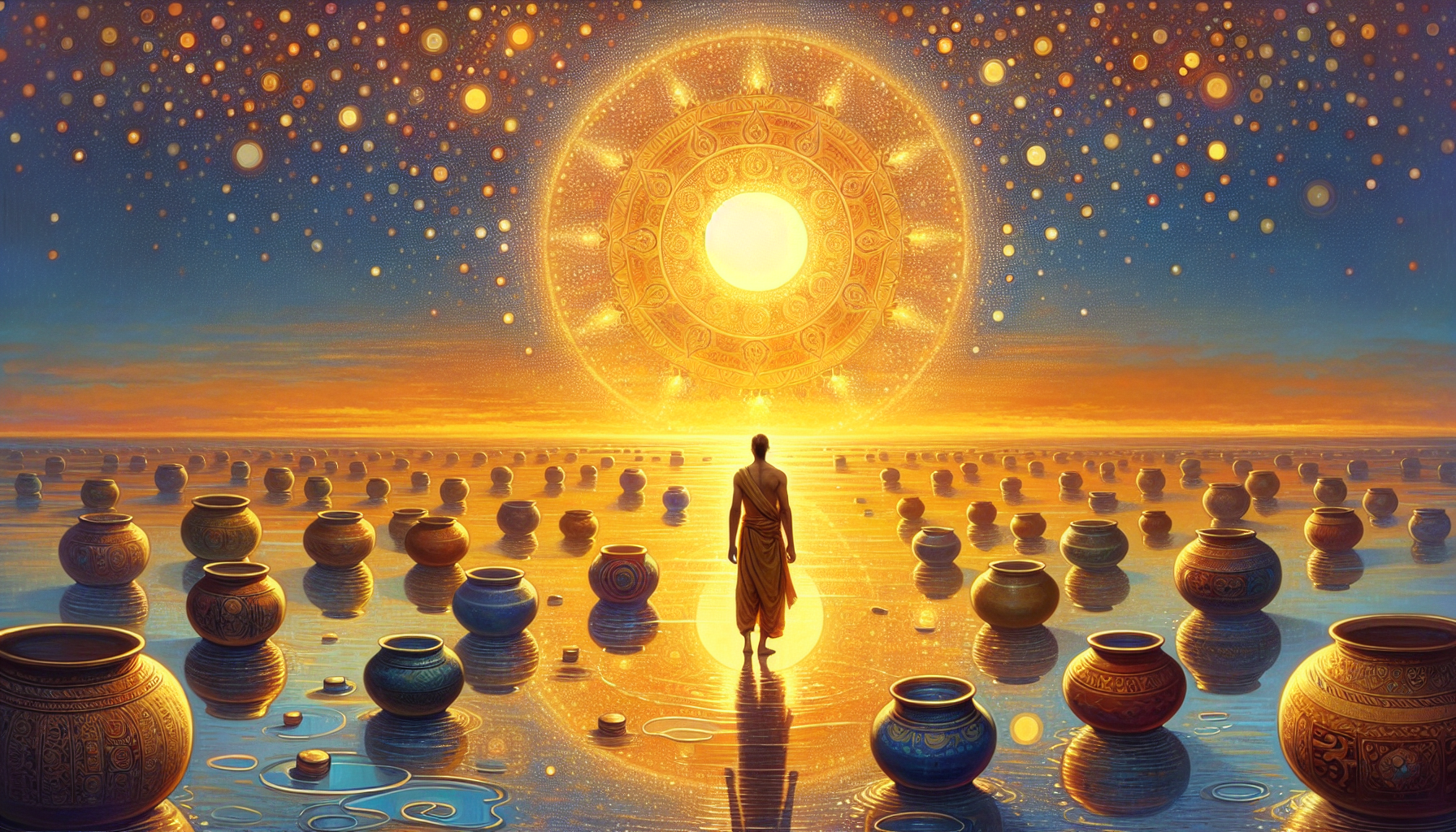
The analogy of the reflected sun makes this vivid. If you are a reflected sun in a jar of water, your existence shakes with every ripple. The only solution to this precarious condition is to realize: I am the Sun. Not the reflection. The source.
The Mind as Cloud: From Obstruction to Illumination
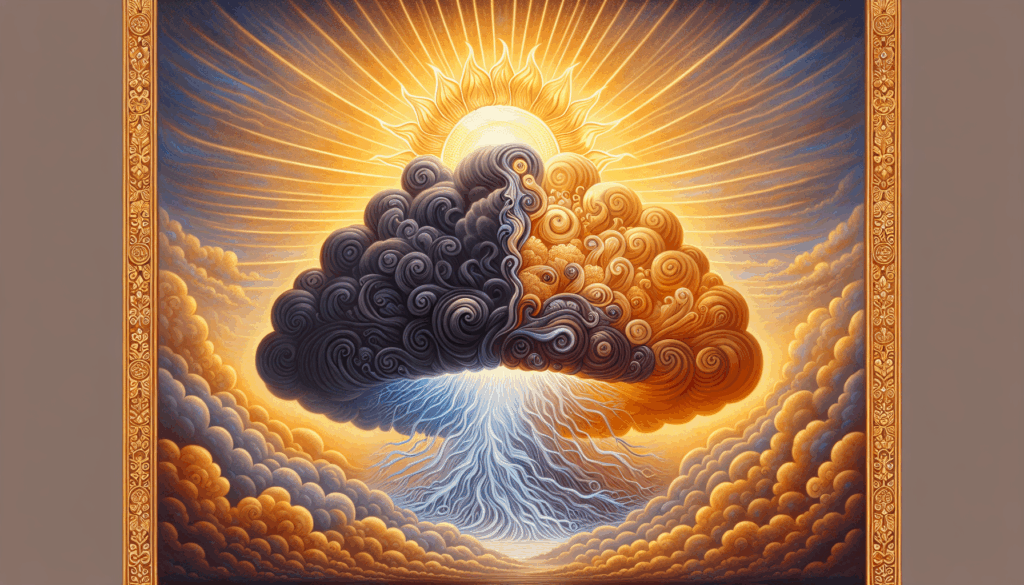
What exactly is the mind? It looks solid, like a cloud in the sky. But analyze it, and you find it is nothing but moisture clinging to dust particles. Thoughts, expectations, and habitual patterns are the fabric of this cloud.
When the cloud is dense and opaque, it blocks the sun entirely. But as spiritual insight develops, the cloud begins to thin. It becomes silvery. The same cloud that was once an obstruction now lets the light pass through, even adds beauty to the sky. This is the shift from impure sankalpa (intention) to pure sankalpa. The mind does not need to be destroyed; it needs to be purified until it no longer obstructs the light of the Self.
From Ignorance to Fulfillment: The Path to Direct Knowledge
The process from bondage to liberation follows a clear sequence. It begins with avidya, ignorance. Ignorance produces avarana, a veil of illusion over the mind. The veil produces vikshepa, distraction. Because you cannot see clearly, you scatter your energy in every direction, chasing things that cannot satisfy you.
Through lifetimes of experience and spiritual practice, indirect knowledge (paroksha jnana) arrives: you study, you reflect, you begin to understand intellectually. But intellectual understanding alone is not enough. It must deepen, through meditation and self-inquiry, into direct knowledge (aparoksha jnana). When direct knowledge dawns, there is absolute fulfillment, what the tradition calls Tripti. This is not conditioned satisfaction that depends on circumstances; it is the recognition of who you already are.
Vishaya Chintan and Brahma Chintan: Shifting Your Focus
The practical instruction at the heart of this teaching is simple to state and vast to practice. Train the mind to shift from vishaya chintan (thinking about the world) to brahma chintan (thinking of God).
Vishaya chintan is the default mode of human consciousness: constantly thinking about past, present, and future, burdening the mind with worries, desires, and reactions from morning to night. Modern technology has only expanded the possibilities for this kind of mental distraction. You can now share your smallest anxieties with people on the other side of the planet in real time.
Brahma chintan is the opposite movement. When worldly thinking begins to slow down, you naturally discover a love that was always present but hidden. The source of this love is Brahman, the Self, which is the embodiment of love itself.
Hanuman’s three levels of relationship with Rama illustrate how this shift plays out in daily practice: “From the standpoint of the body, I am your servant. As a soul, I am your ray. In the deepest truth, I am You.” All three levels operate simultaneously in a life lived with awareness. You serve, you grow in virtue, and you recognize your identity with the Divine. That is integral yoga.
The Real Treasure: What Was Never Lost
King Janaka’s reflection is not a rejection of the world; it is a correction of a fundamental error. The mind has been looking for happiness in the wrong place. Every pursuit of external pleasure is like searching for the sun among its reflections in a thousand jars of water. No amount of reflected suns, gathered together, will ever produce the real sun.
The real sun was never lost. It was only obscured. When the clouds of desire thin out and dissolve, what remains is what was always there: the Self, imperishable, complete, needing nothing from outside to be whole.
This study guide is drawn from the archived teachings of Sri Swami Jyotirmayananda.
thisis a fantastic article, really nice created, i enjoy reading it, i will be back to check out for latest update, keep up the good work and applause. ng.yandaz.com