
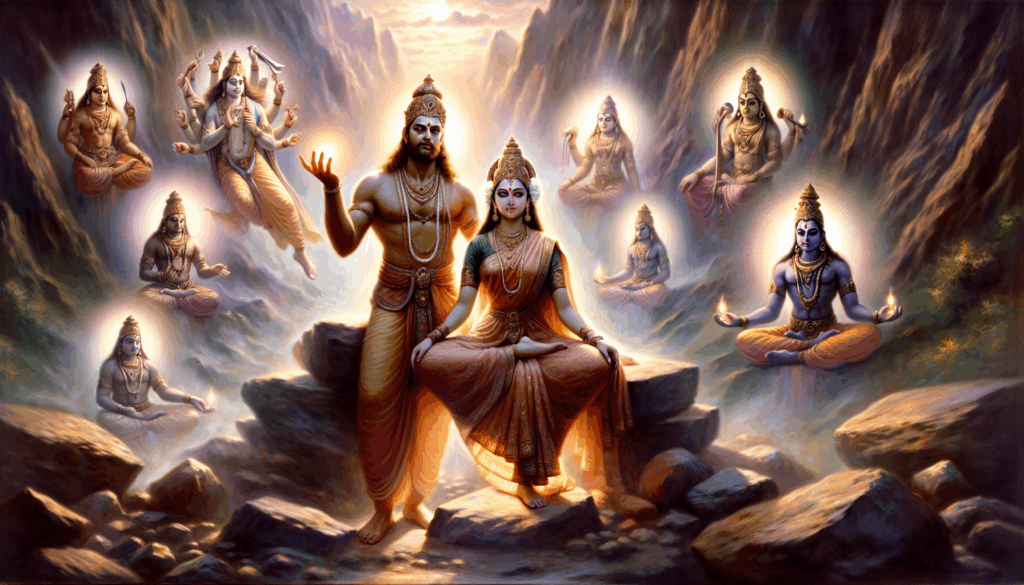
In this profound Tulsi Ramayana teaching, Sri Swami Jyotirmayananda, a direct disciple of Swami Sivananda, illuminates a subtle yet significant danger in spiritual life: even goodness itself can become limited when it remains under the rule of ego.
The lecture delves into the Bala Kanda, Doha 152, a pivotal point where the narrative begins to foreshadow the formidable forces that will later manifest through Ravana. Swamiji masterfully treats the story not merely as a chronicle of external events, but as a rich allegory of our inner life. He emphasizes that strength, virtue, ritual, and success, no matter how admirable, must be guided beyond ego if they are truly to lead toward liberation.
The Story Behind the Rise of Ravana
Swamiji begins by immersing the listener in the sacred narrative of the Ramcharitmanas, as Lord Shiva recounts the tale to Parvati. The narration starts to reveal why the Divine incarnation of Rama is so profoundly needed. It’s not enough to simply know that God descends; we must also comprehend the deep-seated forces of ignorance, pride, and unchecked power that make Divine intervention meaningful and necessary.
The lecture introduces King Satyaketu and his sons, with a particular focus on Pratap Bhanu, a prince of immense power and virtue. On the surface, this appears to be a classic story of royal greatness and achievement. However, on a deeper, allegorical level, it serves as a profound study of what truly happens when even the most commendable greatness remains bound by the confines of ego.
Dharma Must Guide Prosperity and Desire
At this juncture, Swamiji pauses to elucidate the four fundamental aims of human life, known as purusharthas: dharma, artha, kama, and moksha.
- Dharma: The ethical and spiritual foundation, representing righteousness and moral conduct.
- Artha: Material value, resources, and the pursuit of worldly prosperity.
- Kama: The field of human desire, enjoyment, and the fulfillment of social and vital duties.
- Moksha: The ultimate goal of liberation from bondage and ignorance.
He stresses that these aims must remain in their correct hierarchical order. Wealth and desire are not inherently rejected; rather, they must be meticulously governed and guided by dharma. If an individual prioritizes power or material gain first, attempting to appear righteous only afterward, the mind has already veered off the true spiritual path. Genuine goodness, Swamiji warns, cannot be built upon a foundation of deception.
Goodness Is Good, But It Is Not the End
One of the most impactful points in Swamiji’s lecture is his gentle yet firm warning: while being good is undoubtedly wonderful, remaining solely at the level of ego-bound goodness is simply not enough. Consider a student who is making excellent progress but refuses to advance beyond a certain grade; that cannot be considered full success or ultimate achievement.
In the same vein, a person may be highly charitable, widely respected, outwardly religious, and admired by the world. Yet, if that goodness does not fundamentally remove ignorance and purify the inner being, it has not fulfilled its deeper purpose. True virtue should soften the ego, cleanse the heart, and propel the soul toward Truth. Conversely, if virtue merely inflates the ego, becoming a source of pride or self-satisfaction, it paradoxically becomes part of one’s spiritual bondage.

The Inner Meaning of Power and Conquest
Pratap Bhanu is depicted as possessing vast armies, immense strength, abundant resources, and achieving victory over countless lands. Swamiji encourages us to interpret these vivid images inwardly. The foot soldier, for instance, represents action. The horse symbolizes the dynamic movement of feeling. The mighty elephant embodies the raw power of will. And the grand chariot signifies the sophisticated power of the intellect.
These are not just external attributes; they are very real powers residing within every human being. They can be harnessed and directed for profound spiritual growth, or they can be seized and misused by ignorance. When the story recounts the king conquering the seven continents, Swamiji wisely points toward the subtle centers of human personality and consciousness. If ignorance is allowed to rule these inner centers, even the most outwardly capable person will ultimately live a shallow and unfulfilled life.
Ritual, Devotion, Knowledge, and the Missing Freedom
The king performs great works: he builds magnificent gardens, grand temples, essential wells, sacred pilgrimage places, and houses for Brahmins. He diligently performs rituals with devotion and faithfully adheres to the outward forms of religion.
Swamiji acknowledges and honors these actions, but he steadfastly keeps the central question alive: do they truly remove ego? Ritual, devotion, knowledge, and action must ultimately become authentic paths to inner freedom and self-realization. When these noble practices are reduced to mere ornaments of pride, or become tools for self-aggrandizement, they remain incomplete and fall short of their divine potential.
The Boar, the Forest, and the Hidden Plot
The narrative then takes a dramatic turn with the introduction of a mysterious boar. The king, full of confidence, chases it, but the pursuit leads him far away from his army, into a state of exhaustion, thirst, and profound confusion. Eventually, he stumbles upon an ashram that appears holy and serene, yet it is subtly enmeshed in a hidden, deceptive plot.
This is a powerful and cautionary image for the spiritual journey. Ego, driven by overconfidence, can chase after external challenges or perceived achievements and tragically lose its way. The mind may believe it is in complete control, but unchecked pride can cunningly lead it into situations it neither fully understands nor can truly navigate. While the outer story pauses at this critical juncture, the inner lesson has already become strikingly clear: power without humility, and virtue without Self-knowledge, leave the soul dangerously exposed to deeper ignorance and delusion.
The Teaching for the Seeker
The Ramayana, as interpreted by Swamiji, is not merely asking us to admire virtue; it is compelling us to purify virtue itself. Good actions, religious discipline, charity, and inner strength are incredibly precious when they genuinely lead toward God-realization. However, they become spiritually dangerous when they merely foster spiritual self-satisfaction or egoic pride.
Swamiji’s teaching is both gentle and exacting: Do good, practice dharma, serve others, and honor sacred tradition. But do not stop there. Let all goodness lead you beyond the confines of ego, toward profound devotion, liberating wisdom, and ultimate liberation.
Scholar’s Corner
- Ramcharitmanas, Bala Kanda, Doha 152: Swamiji identifies the lecture with Bala Kanda, verse 152, where the narration begins to turn toward the story of the forces that make Rama’s Divine incarnation necessary.
- Invocation to Lord Rama: The lecture opens with a beautiful Sanskrit invocation honoring Lord Rama, whose complexion is compared to a blue lotus, with Sita seated at His side and the bow and arrow gracefully held in His hands.
- The Four Aims of Life: Swamiji explains dharma, artha, kama, and moksha as the ordered aims of human life. Dharma must guide artha and kama, and moksha remains the final, supreme goal.
Glossary of Sanskrit Terms
- Dharma:
- Ethical and spiritual order; the foundation for right living.
- Artha:
- Material value, resources, and worldly means.
- Kama:
- Human desire, enjoyment, and social or vital fulfillment.
- Moksha:
- Liberation from bondage and ignorance.
- Bhakti:
- Devotion to God.
- Jnana:
- Spiritual knowledge or wisdom.
- Karma:
- Action, especially action performed as part of duty and spiritual discipline.
- Upasana:
- Worship, contemplation, and devotional practice.
- Dhyana:
- Meditation.
- Kundalini:
- The latent spiritual power described in yogic tradition.
- Muladhara:
- The root center in Kundalini yoga.
- Sahasrara:
- The crown center, associated with spiritual expansion.
- Ramcharitmanas:
- The devotional Ramayana of Saint Tulsidas.
- Bala Kanda:
- The opening section of the Ramcharitmanas.
Watch the full lecture here: https://youtu.be/0mqn-xsC0aA
Join the Community: https://bit.ly/4dgDWKn
This study guide is drawn from the archived teachings of Sri Swami Jyotirmayananda.