
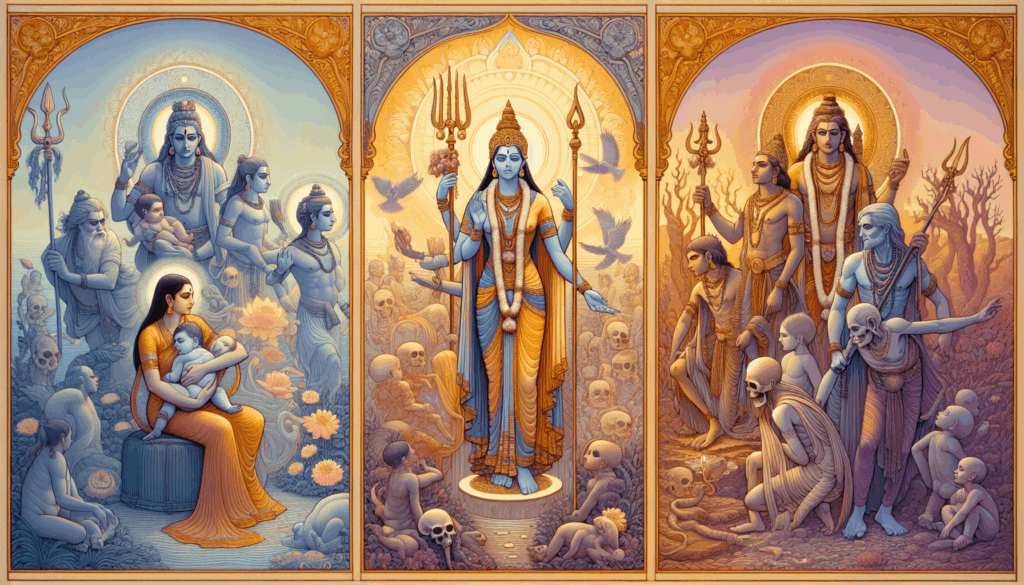
The story of Lord Shiva’s marriage to Parvati in the Ramcharitmanas is far more than just a divine romance; it’s a profound allegory for the soul’s arduous yet beautiful journey towards spiritual evolution. In this teaching, we’ll delve into the hidden symbolism behind the grand wedding procession and the intense emotional drama that unfolds with Mother Maina.
The wedding procession, or Barat, is not a monolithic entity. Instead, it comprises three distinct groups, each representing one of the three Gunas (qualities of nature) that fundamentally make up our world and our inner selves:
Brahma’s Party: Instinctive Goodness (Sattva)
- This group embodies the innate goodness and purity we are born with.
- It symbolizes natural affection and unconditional love, much like the spontaneous bond between a mother and child. This is the foundation of our being.
Vishnu’s Party: Evolved Virtues (Rajas)
- Representing the Daivi Sampat (divine wealth), these are the virtues acquired through conscious effort: culture, study, and good actions.
- This path leads to worldly success, fame, and the development of a refined personality. It’s about striving and achieving within the material realm.
Shiva’s Party: The Path to Enlightenment (Tamas transcended to Vijnana)
- This is the most challenging and often misunderstood party, symbolizing the highest state of Enlightenment, or Vijnana.
- To the worldly eye, Shiva’s entourage—skeletons, ghosts, and unconventional beings—appears terrifying. Why? Because it represents Manonasha, the complete destruction of the mind’s illusions and the radical renunciation of all worldly desires and attachments. It’s a journey beyond conventional beauty and comfort.
Maina’s Grief: Trapped in the Fog of Moha
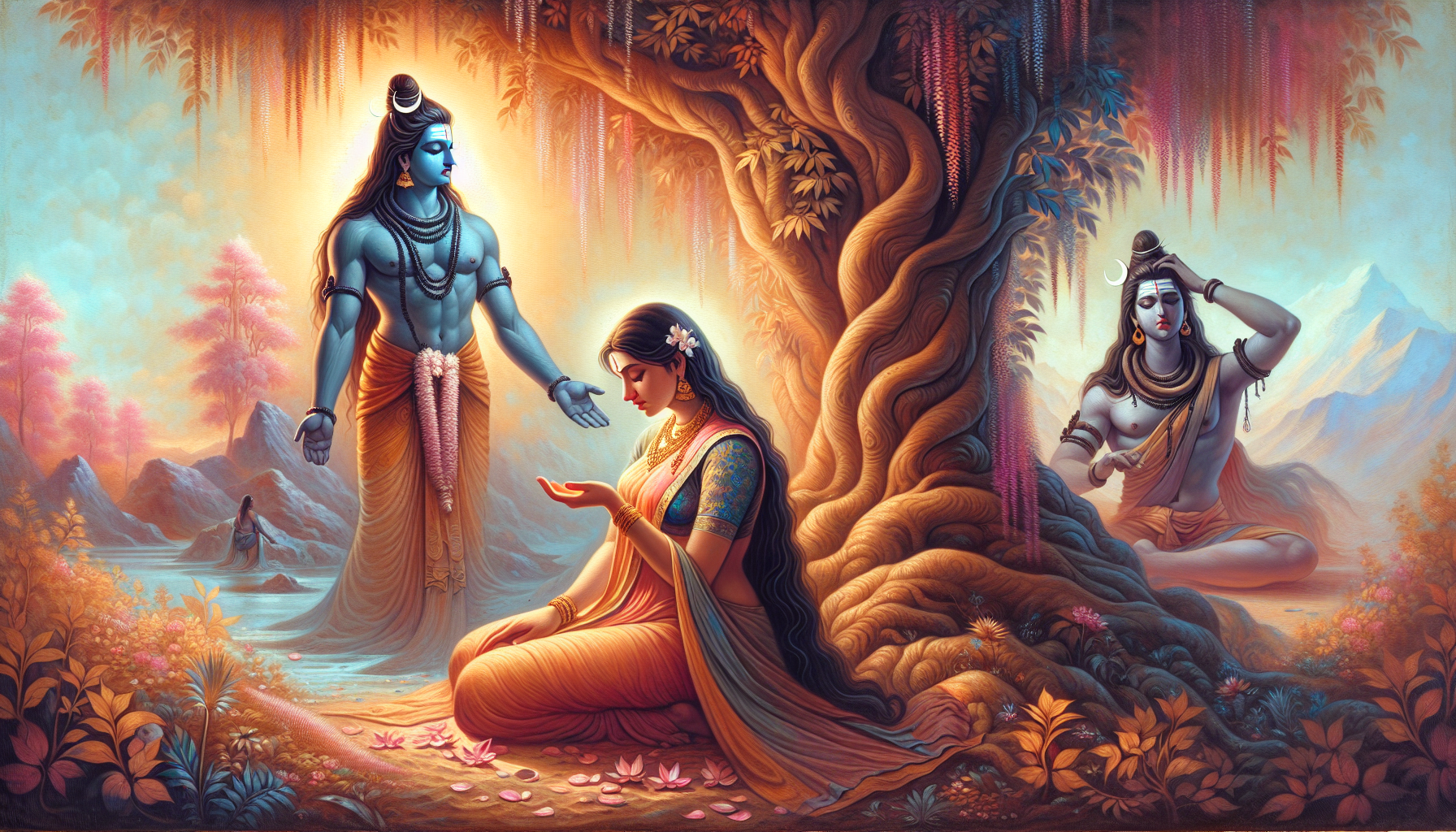
Mother Maina, Parvati’s mother, becomes a central figure in this spiritual drama, embodying Moha—delusory attachment. Her intense love for her daughter is undeniable, but it’s tragically blinded by worldly concepts of happiness and societal expectations.
She longs for a “Kalpataru” (a mythical wish-fulfilling tree) for her daughter’s husband, someone who would bring conventional joy and prosperity. Instead, Shiva appears as a “Babul tree”—thorny, rugged, and far from her idealized vision.
Spiritually, this poignant scene reveals a profound truth: the authentic path to truth and liberation is not about fulfilling the ego’s endless fancies. Instead, it’s about the rigorous process of Neti Neti (“not this, not this”). This path deliberately pricks our ego, dismantling our cherished but false identifications with the body, possessions, and fleeting worldly relationships.
The Role of Satsanga (Narada): Dismantling Ignorance
In her distress, Maina blames Sage Narada for this perceived “disaster.” Narada, in this allegory, represents Satsanga—the invaluable association with Truth and the wise. True Satsanga often feels disruptive and even destructive to the ego.
Why? Because it actively “dismantles the house” of our ignorance, comfort zones, and deeply ingrained attachments. It relentlessly breaks down our identification with the body and the transient world, a process that the ignorant mind naturally resists with all its might.
Parvati’s Wisdom: Embracing Divine Will (Viveka)
Amidst the emotional chaos and resistance, Parvati stands as a beacon of serenity. She embodies Viveka—intuitive wisdom and profound discrimination. With calm resolve, she reminds her mother of an unchangeable truth: we cannot erase the Divine Law.
Whether pleasure or pain manifests in our lives, it is ultimately a result of our own destiny (Prarabdha). By cultivating acceptance of the Divine Will, we transcend the cycles of grief and find lasting peace. Parvati’s composure is a powerful lesson in spiritual surrender.
Scholar’s Corner: Deepening Your Understanding
- Scriptural Reference: Sri Ramcharitmanas, Balakanda, Doha 95. This specific verse captures Maina’s anguish.
- Key Concept: The Saptarishis (Seven Sages) who accompany Shiva’s party can be understood as representing the seven stages of wisdom, known as Sapta Jnana Bhumika:
- Shubheccha (Good desire)
- Vicharana (Inquiry)
- Tanumanasi (Subtle mind)
- Sattvapatti (Attainment of purity)
- Asamsakti (Non-attachment)
- Padarthabhavana (Understanding the true nature of objects)
- Turiya (The fourth state of consciousness beyond waking, dreaming, and deep sleep)
- Memorable Verse: “Jahiṁ vidhi tumahi rūpa as dinnhā | Tehi jaṛa baru bāura kas kinnhā ||” (The Creator who gave you such beauty has lost his mind to give you a mad husband.) This highlights Maina’s human perspective and frustration.
Glossary of Key Terms
- Moha: Delusion or attachment that clouds spiritual understanding and binds us to the material world.
- Viveka: Discrimination; the profound ability to distinguish between the Real (eternal) and the unreal (transient).
- Satsanga: Association with the wise, spiritual teachers, or the Truth itself; a powerful catalyst for spiritual growth.
- Neti Neti: “Not this, not this”—an analytical process of negation used in Vedanta to systematically eliminate false identifications and realize the true Self.
- Daivi Sampat: Divine wealth or virtuous qualities that elevate an individual’s character and spiritual potential.
- Manonasha: Destruction or dissolution of the mind, specifically the ego-mind, leading to liberation.
- Prarabdha: The portion of past karma that is currently manifesting and determining our present experiences; destiny.
Watch the full lecture here: https://youtu.be/4VgDPnjtvnw
Join our Community for more insights: https://bit.ly/4dgDWKn
This study guide is drawn from the archived teachings of Sri Swami Jyotirmayananda.
Thank you for creating this wonderful space.