
In today’s fast-paced world, our minds are often saturated with endless desires, anxiety, and a lingering sense of lack. This constant state of mental agitation creates profound suffering. The ancient cure for this modern condition is presented clearly in the timeless teachings of Lord Buddha.
Drawing from a profound lecture by Sri Swami Jyotirmayananda, a direct disciple of Swami Sivananda, we gain extraordinary clarity on how to truly extinguish the flame of craving and attain lasting peace.
The Illusion of Individuality
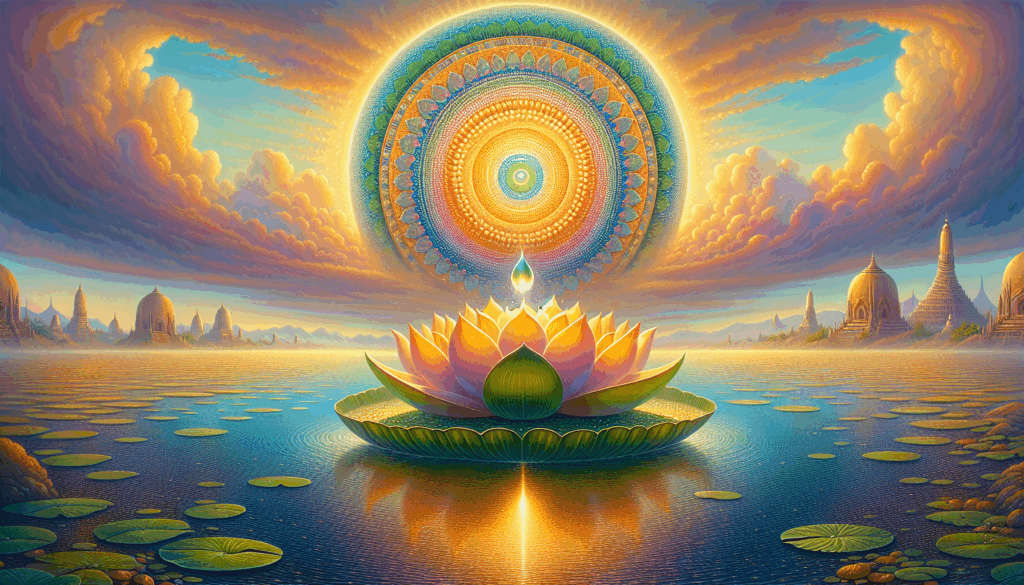
Individuality, as we perceive it, operates on three distinct levels: the physical senses, our sentiments (emotions), and the intellect. Together, these form the intricate tapestry of your personality. However, Buddha teaches that this personality is as transient and ephemeral as a dew drop resting delicately on a lotus leaf.
The most recognized Buddhist mantra, “oṃ maṇi padme hūṃ,” beautifully captures this profound reality. It serves as an invitation to the practitioner to let the “jewel drop of individuality” gracefully slip from the lotus of the heart into the boundless, shining sea of Nirvāṇa.
When one clings steadfastly to the illusion of “me and mine,” they inevitably move from one temporary attachment to another, tragically missing the profound depth and vastness of the ocean itself.
The Four Noble Truths (catvāri āryasatyāni)
At the heart of Buddha’s philosophy lies the crucial recognition and systematic addressing of the root of human suffering. These are encapsulated in the Four Noble Truths:
- The Reality of Pain (duḥkha): The fundamental understanding that repeated embodiments and cycles of existence inevitably bring distress and dissatisfaction.
- The Cause of Pain (duḥkha-samudaya): Identifying the source of this suffering as endless craving or intense desire (tṛṣṇā).
- The Cessation of Pain (duḥkha-nirodha): The liberating truth that there exists a state where pain ceases entirely and permanently. This state is known as Nirvāṇa.
- The Path to Cessation (duḥkha-nirodha-gāminī-pratipad): Finally, the practical method for attaining this cessation of suffering: the Noble Eightfold Path.
The Noble Eightfold Path (aṣṭāṅgika mārga)
To purify the heart, transcend suffering, and attain ultimate liberation, Buddha meticulously presented eight interconnected practices. These are not sequential steps but rather aspects to be cultivated simultaneously for holistic spiritual growth:
- Right Views (samyag-dṛṣṭi): Cultivating a deep and accurate understanding of the true nature of life, suffering, and the essential necessity of liberation.
- Right Resolve (samyak-saṅkalpa): Fostering a firm determination to perform only those actions that purify the mind and uplift the spirit.
- Right Speech (samyag-vāc): Practicing honesty, kindness, and mindfulness in all verbal communication, refraining from falsehood, harsh words, gossip, and idle chatter.
- Right Action (samyak-karmānta): Engaging in ethical conduct, practicing non-violence (ahiṃsā) towards all beings, and refraining from stealing or sexual misconduct.
- Right Livelihood (samyag-ājīva): Earning one’s living in a way that is pure, honest, and does not cause harm to others or the environment.
- Right Effort (samyag-vyāyāma): Continuously striving to prevent negative thoughts from arising, overcome existing negative states, develop positive thoughts, and maintain positive states.
- Right Mindfulness (samyak-smṛti): Developing a detached and non-judgmental awareness of one’s body, feelings, mind, and mental objects, observing them as they arise and pass away.
- Right Contemplation (samyag-samādhi): Achieving deep meditative absorption, leading to states of profound concentration and inner peace.
By diligently practicing moderation (madhyamārga) and sincerely following these eight steps, the mind gradually becomes free of all impurities. This profound purity then opens the window to spiritual knowledge (prajñā), allowing the seeker to finally blow out the flame of craving and experience the bliss of Nirvāṇa.
Scholar’s Corner
“ātmā is the Lord of one’s own self. None else can be the ruler of oneself. By conquering the self, one attains Nirvāṇa, which is the highest attainment.”
— Dhammapada
“Buddha calls it Nirvāṇa, Vedānta calls it Brahman. And the Bhagavad Gita puts them together… brahmanirvāṇa.”
— Sri Swami Jyotirmayananda
Glossary
- Nirvāṇa: The ultimate cessation of pain and craving; the state of ultimate liberation and perfect peace.
- Śūnya: Void; the profound concept that all transient experiences and phenomena lack ultimate, inherent reality.
- Duḥkha: Pain, suffering, dissatisfaction, unease, or stress inherent in existence.
- Tṛṣṇā: Craving, intense desire, thirst, or attachment that fuels suffering.
- Aṣṭāṅgika Mārga: The Noble Eightfold Path, Buddha’s prescribed method for the cessation of suffering.
- Madhyamārga: The Middle Path, advocating moderation and balance, avoiding extremes of indulgence and asceticism.
Watch the full lecture here: https://youtu.be/CYQ_KIs2FNI
Join our spiritual community: https://bit.ly/4dgDWKn
This study guide is drawn from the archived teachings of Sri Swami Jyotirmayananda.